Sunday, June 19, 2011

Day 60 - Green Lantern

Green Lantern (2011) directed by Martin Campbell


First, I will point out that it would be impossible to make a Green Lantern movie without extensive use of CGI. It's just not possible. His ring is extraterrestrial in nature, his allies and enemies are aliens, he can fly, travel through space and his power is unique in that he creates whatever he imagines into reality. Need to combat a relentless enemy? No problem, create a machine gun out of pure energy and blast away. How to block an oncoming attack? Create a brick wall. Save a falling girl? Make a pool of water to catch her. You get the idea.

So naturally, Green Lantern is full of special effects and CGI. The opening sequences are much like Thor. We see the backstory in outer space with alien and mythical beings, Earth light years away. For some reason I wasn't as perturbed about this as I was in Thor perhaps because I have grown more tolerant of it and that this backstory isn't nearly as long. Also while Thor at times feels like Lord of the Rings, Green Lantern is more like Star Wars. (I don't know what that's really supposed to mean, but I'm using it as a compliment for Green Lantern even though I like Lord of the Rings. It just seems like Star Wars is better source material for a super hero.)

An ancient cosmic being named Parallax breaks loose from his prison and is out to wreak havoc on the universe. The universe is guarded by the Green Lantern Corps, a sort of intergalactic police force. They are powerless to stop Parallax as he grows stronger and stronger. One of the Green Lanterns who encounter Parallax is gravely injured and he manages to escape and crash land on to Earth. One of the qualities of the Green Lantern's ring is that if its owner dies it will choose a new hero to wear it. Of course, it picks our hero, Hal Jordan (Ryan Reynolds).

Hal is brought to the Green Lantern headquarters on the planet Oa. After the obligatory moment of shock which lasts like 45 seconds, Hal starts to learn what it means to be a Green Lantern, how it must require great responsibility and fearlessness. Hal is unsure if these qualities fit him. He is a brash and seemingly irresponsible guy and while he won't admit it to himself, he is deeply afraid. "I'm only human," he says. "The ring chose you for a reason, Hal Jordan. The ring is never wrong." Naturally, Hal must spend the rest of the movie finding his courage and figuring out what it means to be a hero, face evil, care for others, show that being human is a virtue, not a weakness, etc etc. All the while, Parallax draws closer and closer...

Especially grand comic book titles must deal with the impossible task of explaining what the hell is going on while establishing characters, setting up a plot and filming big action sequences, so a lot of the time its going to be a mess. Spiderman's story is pretty simple, he's bitten by a radioactive spider and gets his power. Batman is just a dude with lots of money. But once you start introducing more grandiose elements like a mystical force, alien beings and their intergalactic battles, things get a lot dicier and harder to keep track of. Green Lantern tries to take its story and themes seriously, but in its heart its really just a big silly action picture and basically a vehicle to show off all the visuals.

Ryan Reynolds is charming and funny, but he looks pretty goofy in his green suit. Once you get past that though, you'll zig and zag and fly around with him throwing big green punches. He does the best he can with a script that tries to humanize Hal, show him as cocky and vulnerable, but there are no real big revelations about his character. It sort of just follows the standard script. Blake Lively plays his love interest and is pretty flat, something about her voice throws me off, but she is quite pretty. While Parallax is the ultimate evil force on his way to earth, Hal's human counterpart is Hector Hammond, who looks slithery and kind of like a pedophile with his wispy mustache. Being a villain is always more fun and you can tell. Though he has limited screen time compared to Hal, you get a greater sense of his complexity.

There are stupid moments with corny dialogue. There are cliche moments and predictable turns. There are also some laughs and thrills, heroes and villains, a damsel in distress and all that comic book goodness you come to expect. Just sit back with some popcorn and try not to think too hard and just enjoy all the pretty lights.

Grade: B-

Saturday, June 18, 2011

Day 59 - The Circus

The Circus (1928) directed by Charlie Chaplin


I'll be honest. I was a little wary of watching silent films going into this project, but now I love them! I can't believe i hadn't watched a single Charlie Chaplin film until a couple months ago, but now I've watched three and can't wait to watch more!

Anyways, The Circus follows Chaplin's famed Tramp in yet another adventure. By now I've grown accustomed to his quirks and themes; he's a down on his luck vagrant who by chance always finds himself in these wacky situations. He has a heart of gold and will invariably connect with another down on her luck character often rescuing them from their hardships.

In this story, the Tramp finds himself on the run after a pickpocket gives him a wallet in order to avoid being caught. The Tramp can hardly believe his luck and parades around with his new wallet. Unfortunately the real owner of the wallet sees it and, uh oh, the Tramp is in trouble. The following sequence is one of the funnier action sequences I've seen Chaplin in, maybe on par with the boxing scene in City Lights. Here he gets chased around a funhouse and gets trapped in a maze of mirrors. The scene is extremely well choreographed or these mirror shots are a lot easier to film that I'd imagine. Either way, I was pretty impressed as he bumped and backed into his own reflection in multiple ways and angles. It gets even dicier when the cop gets in there with him for double the fun. I found myself laughing out loud several times during the chase scene. Eventually, he runs into a circus act where he unwittingly becomes a huge hit through his bumbling and stumbling.

The circus director, a rather menacing figure, sees the Tramp's star power and hires him as hired help without telling him that his comedy act will actually be the main attraction. The Tramp soon meets the director's daughter, who is often beaten or denied food for messing up performances. I was kind of taken aback by the back handed slap the father gives his daughter. I know it was standard practice for slapping women in films back in the day but it is always kind of shocking to see. Even in light hearted family friendly comedies like The Circus, no woman is safe.

Anyways, naturally the Tramp and the girl become buddies. The Tramp falls for her but soon a new guy, a tight-rope walker, enters the fray and catches her eye. The Tramp is jealous and disheartened and suddenly his act isn't so funny anymore. There is another impressive sequence where the Tramp must take the tight-rope walkers place in his act. He is assisted by a wire to prop him up and he is able to do impossibly impressive stunts on the rope until the wire comes loose and he's up there all by himself. Oh, there are also monkeys. The stunt work is enough to make Jackie Chan blush. Apparently this film required over 200 takes as Chaplin wanted it perfect.

SPOILER ALERT:

I was pretty surprised by the ending when the Tramp does not get the girl. Maybe it was too perfect of an ending for the girl and the Tramp to run away together? Instead he enlists the tight-rope walker to marry her because he can provide more for her than he can. It seems like an awfully pessimistic and pragmatic solution for an otherwise perfect romantic set-up and the Tramp seems way too happy about it. I know he is happy to see her happy, but it would have been better to see him a little beaten down about his decision. In a way I suppose it is somewhat of a fitting ending given that the Tramp will always be an outcast in society. But if Chaplin really felt this way, why does he get the girl in City Lights? The ending is a little sad when he walks alone into the horizon but has nowhere near the impact of his two masterpieces I've seen, Modern Times and City Lights.

END SPOILER

The Circus is a timeless comedy full of light hearted laughs. It is more of a standard comedy rather than a masterpiece though and I felt that the ending could have went a different route to give it a more complete feeling.

Note: I must have watched the 1967 re-release of the film where Chaplin sings the opening credits. If I remember correctly, Chaplin's voice isn't heard on film until the end of Modern Times. He has a magnificent booming voice and clearly could have transitioned into the talkies must quicker if he wanted to. In fact, The Circus was released around the same time as The Jazz Singer, the first full length talkie.

Grade: A-

Friday, June 17, 2011

Day 58 - The Night of the Hunter

The Night of the Hunter (1955) directed by Charles Laughton


This was a really weird one to watch. I got so many different vibes from The Night of the Hunter without really knowing why. At times I was thinking of how creepy it was, other times how absurd everyone sounded and always marveling at what a great villain Harry Powell (Robert Mitchum) is. Also I couldn't help but think of other movies that this film reminded me of.

Apparently this film was a critical and commercial failure upon its release, but now is heralded as a bonafide classic. Not every classic is a classic right away, it often takes time for people to realize exactly what they've watched. Some of the greatest works of art were universally hated when released. Perhaps I am not mature enough in my movie watching years because I'm sure that I am not appreciating this film as much as I should be. I thought it was decent but not great.

The film starts off with Ben Harper with the cops on his tail. He's just robbed a bank for $10,000 and must hide it. He tells his children John and Pearl where he hid the money and makes them promise to never tell anybody where the money is. Ben is sentenced to death but before he dies he shares a cell with a con man/killer who fancies himself a man of God, Harry Powell. (The very beginning of the film warns of false prophets.) Harry wants to know the location of the money but Ben won't tell him. Harry suspects that his children know and when he gets out finds his way to their little town in Ohio. He manages to gain the trust of John and Pearl's vulnerable mother and they are quickly married. Enter evil step-father angle.

Speaking of which, I didn't see the 2009 release The Step-Father, but there is no doubt that image of his shadowy figure on top of the basement stairs that adorned its box art would not exist without The Night of the Hunter and I'm sure countless other horror films owe the evil step-father angle to this movie as well. So he wants to know where the money is but the kids aren't telling. He loses his patience and the evil side is revealed. The two kids flee the house after its evident Harry is going to kill them and spend the latter half of the film on the run floating upstream the Ohio River with Harry hot in pursuit.

One of the lasting impressions of No Country for Old Men is the nightmarish chase between Javier Bardem and Josh Brolin. There, Bardem is relentless and terrifying. I couldn't help but think of  No Country when seeing this picture from The Night of the Hunter. Here is a shot of Harry coming over the horizon in the countryside. His shadowy figure is ominous and ubiquitous, the stuff of nightmares. When John and Pearl are floating down the river, you can't help but notice how surreal it all looks. I didn't quite grasp the notion of the dream-like nature of it until reading about it afterwords but it makes perfect sense.

There are a lot of striking visual shots in this film. I could post a bunch of great black and white shots but you could see them pretty easily on Google. One in particular, without trying to give away the plot, is both mesmerizing and terrifying at the same time. If you watch the movie you'll know exactly what scene I am talking about.

There is a lot of religious talk in the movie. The villain, Harry, is a preacher after all and it would be fitting for a bunch of God-fearing folk for the time period in the south. I feared that I might be missing a more important overarching theme here but still can't really figure one out. There is a certain rhythm and lyricism to how people talk, but I wish they would just focus more on the chase. However, that is part of the charm in Harry Powell. He has an eloquent and magnetic voice befitting of a preacher, but is also the same voice of a con man.

I've never heard of Robert Mitchum before, but he is scary good as Harry Powell. He is handsome but clearly dangerous and you wouldn't be blamed if you got the shivers from him. He has a legitimate all time villainous aura here. Roger Ebert mentions in his Great Movies essay of Mitchum's performance that it is timeless in the way that we'd expect Anthony Hopkins as Hannibal Lecter will be forty years from now.

However, there is something oddly unsettling about the pace and rhythm of the movie. I couldn't quite get into it one way or another. Perhaps part of it was the odd mixture of styles and genres. It is part horror and part thriller, but also absurd and humorous. It has an almost fairy tale ethos to it, yet we are expected to be genuinely terrified by it as well. These conflicting and contrasting styles may be what make The Night of the Hunter a classic, but it can also be the source for criticism as well.

Grade: B

Thursday, June 16, 2011

Day 57 - Shadow of a Doubt

Shadow of a Doubt (1943) directed by Alfred Hitchcock


I dunno. This one is universally acclaimed but I thought it was merely good rather than great. Part of the reason is that there really was no suspense to this film which is strange since I'm skimming through reviews saying how suspenseful it is. Perhaps part of me was looking for more twists and turns and hold your breath moments, but the film progresses exactly as how you'd expect it to. The film's title, Shadow of a Doubt, is kind of ironic since there really is no doubt at all. There aren't really any hidden clues or stealthy detective work going on as all the clues and details are presented rather matter of fact with little intrigue.

The film opens with Charlie (Joseph Cotten), a man hiding something and on the run. The birds eye view chase sequence between him and his two pursuers is well shot and exciting to watch even if it only lasts a minute or so, but it gives promise for the tone of the rest of the film. He sends a telegram back west to Santa Rosa, California where he has family, telling him he's coming to town to visit. The film then shifts over to said family. In typical Hitchcock fashion, the director paints a picture of normality in introducing the daily lives and routines of the family. I've noticed that many of his films typically start off slow and completely normal. They almost never open with action sequences or suspense, those elements are only introduced later after establishing characters and setting and so forth. It is what makes the scenes of violence or suspense even more jarring, as if to tell the viewer this could be happening to you right now in your very normal lives and setting.

Young Charlie (Teresa Wright), Uncle Charlie's niece of whom she is named after, is bored with her every day life and is excited that her uncle, whom she adores, is coming to visit for a while. Uncle Charlie is kind and charming, even giving every member of his extended family lavish presents. But he is also strangely mysterious and extremely guarded. He doesn't really go into details of what he's been up to back east and refuses to ever have his picture taken. From what we already know in the beginning scenes, we know he is hiding something, but exactly what? Is he a good guy that's hiding from bad guys? Is he a plain old bad guy? Or is it all simply a big misunderstanding? The intrigue for the viewer, and eventually Young Charlie who grows suspicious of her uncle's behavior, is to find out exactly what he's hiding. But therein lies the problem. You never get the impression that Charlie is anything but what he is being portrayed as. He is clearly a shady individual and when it's finally revealed what he's done, it isn't even that big of a shock.

So now Young Charlie knows the truth, but what is she going to do about it? Apparently not much. And Uncle Charlie will come to know that she knows, but what will he do about it? Apparently not much either. You never get the impression there is any danger at all going on until at least the end when it is not at all so subtle or mysterious.

I will say though that this film has plenty of great performances. Joseph Cotten is as handsome and charming as he is devious and sly as Uncle Charlie. Teresa Wright plays the part of the innocent girl turned investigator to a tee. You can sense just how uncomfortable she gets around her uncle through her nervousness and fleeting eyes that seem to always look away. Even the supporting cast is full of interesting characters. The youngest daughter Ann is adorable as a precocious young girl who is always reading something. "I've made a goal to read two books a week," she explains.

The film has some good comic relief in the interactions between the father of the house, Joe, and his friend Herb. Both are obsessed with murder stories and talk casually of how they would hypothetically kill each other. Joe opts to go for a blunt instrument to the head for simplicity sake. Herb objects, stating there is no sophistication at all and would make a terrible story. Joe retorts, "I don't care about stories, I'm just trying to kill you!" They have several other humorous conversations of the same matter throughout. How casually they talk about murder is funny, but also quite morbid especially when you realize there is such a shady character in the house in Charlie.

Shadow of a Doubt is well crafted and well acted, but the story itself lacks the thrills and chills I'd expect from Hitchcock. Still a solid movie though.

Grade: B-

Wednesday, June 15, 2011

Day 56 - Chop Shop

Chop Shop (2007) directed by Ramin Bahrani


Chop Shop is about Ale, a twelve year old street kid, and his every day grind. He's tough and street smart, hustling candy bars and bootlegged DVDs for a couple bucks but his main job is at an auto repair shop in Queens, NY where the owner allows him to live in a shabby room above the shop in exchange for work. He is joined by his older sister Isamar who comes to live with him. His tough demeanor immediately softens in her presence, she is the only family that he's got. He proudly shows off his room, exclaiming that it has a microwave and refrigerator. He opens the fridge and it's stocked with sodas. What more could anybody want?

Ale's ultimate dream is to own a taco truck and work for himself, pretty ambitious plans for a twelve year old. You almost forget that he is only twelve as his hard exterior and tough lifestyle would be impressive for even someone twice his age. The truck he wants is $4500, a seemingly impossible amount for someone so young, but he's been saving up in his coffee jar keeping track of every dollar. The owner of the shop gets annoyed when Ale counts his day's pay in front of him, but every dollar has to be accounted for. Isamar supports Ale's dream and contributes her own money to the stash in her own ways. In a heartbreaking scene, Ale discovers just how hard she has to work for the extra cash. Despite being much younger than his sister, he tries to take care of her by working twice as hard, buying her sneakers, running through the rain to suggest a tip jar for extra money at the food stand she works at in her day job.  Ale learns tough lessons about life and must grow up fast. He's already grown up so fast.

One of the remarkable things about Chop Shop is its naturalistic approach. It reminds me of what I read about Italian neorealism when I watched The Bicycle Thief. Italian neorealism typically deals with the lower working class and poverty, often using real people instead of actors and real locations. From what I understand, virtually no one in the film is a professional actor, just regular people from around the area, and all the scenes in the film are shot on location. In the scene where Ale snatches a purse, no one else is in on it but Ale and the victim, the extras don't even know there's a camera around. (What if Ale actually got caught and beaten by someone trying to stop him?)


The little neighborhood where Ale and the rest of the people in the film live in is dirty and dingy. Scrap metal and debris are everywhere. People just casually roam the streets, hanging out or doing their thing. This is a small neighborhood in Queens next to the old Shea Stadium, but at any given moment you might think they were in a shantytown in Lagos or a favela in Rio. It's kind of shocking that this is all happening in our very own backyard. But it is when Ale and his friend visit Shea Stadium to catch a game do you realize exactly where they are and the stunning contrast between the bright lights and pristine green grass of the stadium with the cold hard concrete world they live in is quite remarkable.


There is also no musical score to this movie until the credits roll at the end. All the sounds from the film are natural. In some of the emotional turning points of the film it would be easy to cue some dramatic music, but I actually appreciate the natural setting the film goes for. The sounds of the street serves as its own soundtrack as they have a rhythm of their own. The sounds of bustling traffic, people chattering, dogs barking, the machinery from the repair shops all have a nice ebb and flow to it. It is kind of a reminder that we're watching real life more so than a movie.

While the film is pretty short, just over 80 minutes, it is more than enough to get us a close look into the every day lives of the characters. By the end of it we feel like we know them all and what they must go through to survive. I feel kind of guilty by leaving them on their own at the end, but a little thankful that I was just a passerby in their lives. The film doesn't really have a true ending point, it sort of just ends. It just reminds us that after the movie is over and we go on to do our own thing, they will still be there doing theirs.

Grade: B+

Tuesday, June 14, 2011

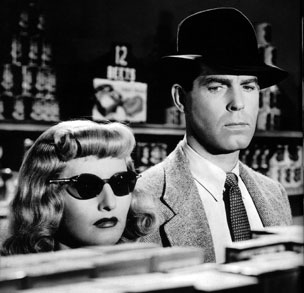
Day 55 - Double Indemnity

Double Indemnity (1944) directed by Billy Wilder


I've been on the road the past couple days and will be for the foreseeable future. That means I'll be away from my home computer and my DVD collection, so I figured this trip would be challenging for my movie watching. The last thing I want to do is stay cramped up in my hotel room for four hours a day, but them the breaks as they say. Luckily, most hotels these days have wireless internet so I've been able to stream off Netflix and post these entrees. Unfortunately, the last hotel I was in had a spotty connection and it adversely affected my viewing of Double Indemnity. The resolution would suddenly get blurry and the frame rate a little choppy, which is a shame because most film noir that I have seen looks great with all the dark shadows and low key lighting, so it was kind of hard to appreciate this film visually. Nonetheless, the times when the image was sharp I thought it looked great.

Double Indemnity may very well be the best movie in the film noir genre. All the preconceived notions you may have of the genre is here; the morally ambiguous protagonist, the mysterious female lead, plotting, scheming, and, gasp, murder! There's the sharp tough guy dialogue and the cool interaction between the male and female leads. Obviously there is the signature cinematography with all the shadows and lowly lit rooms.

Sometimes I hate writing about obvious classics because what can I say that hasn't already been said? Any kind of profound insight I may have has undoubtedly already been said and probably much better so instead I'll just write about my impressions of the film.

First, there is the story. Walter Neff, an insurance salesman, walks into his office late at night, wounded and tired. He begins talking into a recorder and basically confesses to the entire plot of the movie. He says, "Yes, I killed him. I killed him for money, and a woman, and I didn't get the money and I didn't get the woman. Pretty, isn't it?" Then he tells the story in a flashback, how he meets Phyllis Dietrichson, how he immediately falls for her, and how they conspire to and ultimately murder her husband in an insurance scam through a double indemnity clause that pays double for a certain kind of death. Given how he is telling the story in this manner and says that he doesn't get the girl or the money, something clearly goes wrong, but what and why? This flashback narrative got me to thinking if whether or not the tension and suspense of the film is weakened since we sort of already know what happens. Since we are seeing the end of the movie at the beginning, we know the film has to progress in a certain direction to get to that point. Would the story be better told from the beginning rather than the end? It's hard to say but for Double Indemnity it almost doesn't matter because it is so well written.

Another thing I noticed is just how cool the dialogue is. Take for example the first encounter between Walter and Phyllis where they playfully flirt with each other. If you actually dissect's Walter's lines, clearly he is stepping out of bounds and is kind of a douche, but it doesn't matter because he sounds so cool saying it. Would you be able to hit on a married woman like that? The hard edged dialogue in the film was written by Raymond Chandler, a well known novelist at the time but new to Hollywood screen writing. He was hugely influential in the way hardboiled writing was written.

Sorry if this post is lacking in any analysis, but the film is so wonderfully shot, written, and acted and is such a heralded classic it seems almost pointless to heap more praise upon it, so I'll just say I loved this film and leave it at that.

Grade: A

Monday, June 13, 2011

Day 54 - High Noon

High Noon (1952) directed by Fred Zinnernann


I've seen DVD's and movie posters of High Noon and they all usually have the same box art, a shot of the iconic Gary Cooper walking proud and tall with his shiny sherif's badge, but I think this screen shot is a better representation of the movie. Here it shows Will Kane (Cooper), a single man patrolling the streets of a town all alone.

This isn't a traditional western per say. There are no horse chases or wild shootouts. It's a purposely slowed down drama with a lot of dialogue and a character study on bravery and standing up for justice, or in the case of the townsfolk, backing away from it. While in the traditional western, the heroes are made heroic by superficial deeds on screen, Kane is heroic for simply doing what he believes he must do. In a nutshell, High Noon is a morality tale.

Frank Miller, a bad bad man, has just been released from prison and is due to arrive in town on the noon train. His old posse is waiting for him at the station and when they meet up they plan on getting back at the man who put Miller away, the town's marshal Will Kane. Kane, recently married and literally on the last day of his job, is ready to give up his badge and start a new life until he hears the news of Miller's eminent arrival at noon. He has a little over an hour to round of some volunteer deputies to help him confront Miller, except that nobody wants to help for various reasons. Most of it, understandably, is out of fear and some of it believing it's Kane's fight and not the town's. A lot of it also has to do with mob mentality, leaving Kane out to hang. It is hard being the one person to stand up when no one else does. Kane gets turned down left and right and as the time draws closer it is becoming evidently clear he may very well have to face the Miller and his men all alone.

So obviously the film is driven by Cooper who basically carries the movie (he would go on to win the Academy Award for best actor in this role), but the thing that really struck me is the great musical score. First there is the folksy but ominous theme song with lyrics foreshadowing the inevitable showdown between Kane and Miller. There is that recurring track that kind of reminds me of the music in Yojimbo.

Speaking of which, playing around with the audio commentary for the Yojimbo Blu-ray, I learned that High Noon had some influence on the samurai classic. The coffin maker who anticipates increased business with brewing trouble is used in both movies. Another thing that I try to notice but don't ever really are how pictures are composed on screen. In the audio commentary of Yojimbo, there is a mention of layered scenes in which in the foreground there is the main action and through the window you can see another scene going on outside. The classic example of this is the deep focus shots of Citizen Kane. In High Noon, there's a scene where Kane is talking to another man and you can see a man approaching through the window and a couple seconds later the door opens and there he is. Not earth shattering stuff, but pretty cool to think about.

Apparently this film was disliked by some when it came out due to its supposed communist sympathies, namely that it serves as an allegory to standing up to the HUAC. John Wayne hated it and even called it "the most un-American thing I've ever seen in my whole life." He and director Howard Hawkes, a fellow hater that basically called the Will Kane character a coward for asking everybody for help, teamed up to make Rio Bravo, a supposed response to High Noon. This is all pretty ironic considering that High Noon was blasted by the Soviet Union who characterized it as "a glorification of the individual." Haters gonna hate.

I think this is a fantastic movie highlighted by a big performance by Cooper as Will Kane who, in my eyes, is clearly a heroic figure. I've only seen a couple John Wayne movies, The Searchers and True Grit off the top of my head, but I was never all that impressed by his screen persona. Maybe its because he represents an unrealistic portrayal of the masculine ideal while Cooper's Kane is more human which makes his deeds even greater and more heroic.

Grade: A