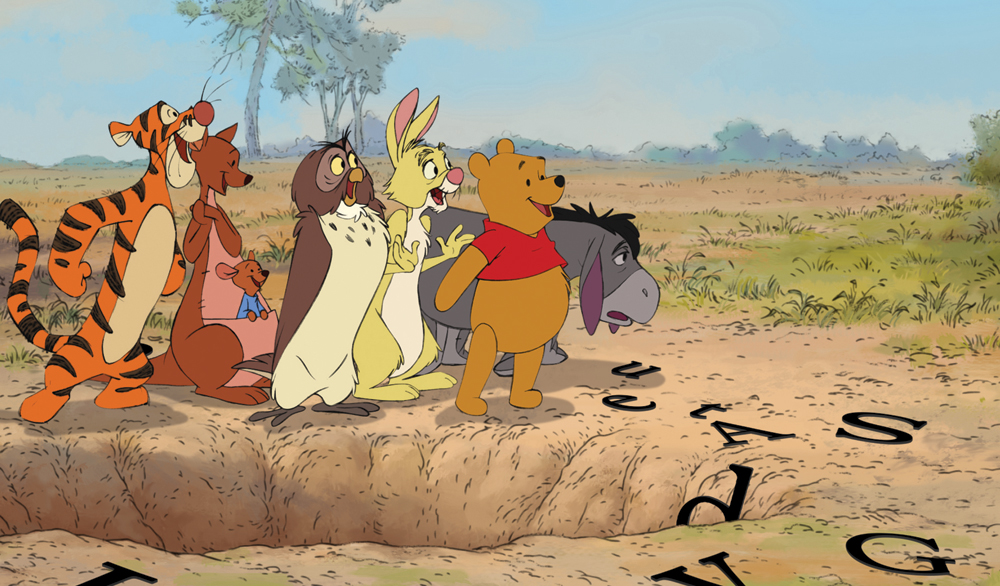
Winnie the Pooh (2011) directed by Stephan Anderson
So while the rest of the world was watching Harry Potter, I decided to watch Winnie the Pooh. The film is sweet, charming and decidedly very child friendly, even more so than typical Disney fare. Looking back at the old Disney classics, I was genuinely surprised that they are all rated G and not PG. The Lion King, for instance, can be very scary and traumatic. Rest assured, kids will be safe watching the lastest adventures from the Hundred Acre Wood. That is of course if you can get past Pooh's tragic drug addiction.
Yeah, I said it, Pooh is a drug addict. He mopes around on screen determined to find drugs, practically begging his friends to let him have a little hit. He is fiending so badly that he has hallucinations where everything he sees or hears resembles that sweet sweet stuff. What is more troubling are kids reactions to Pooh's series of misadventures. Kids laugh at Pooh as he gets worse and worse, leading me to wonder how they will grow up treating the homeless and drug addicts. While Requiem for a Dream shows people the dark and depressing side of drug abuse, Winnie the Pooh teaches people to mock it and ignore it. I can just imagine these six year olds ten years from now mocking homeless people on the street. They'll look at them with bemused scorn and say, "Pull it together, Pooh Bear!"
Also, Winnie the Pooh teaches kids it is okay to treat your friends badly. Look at how badly Pooh treats Piglet! Pooh makes Piglet go get some drugs for him, leaving him in a precarious situation. Rather than attempt to help Piglet, Pooh's concern is for the drugs first. Then when the drug dealers chase the two, he makes Piglet give him a piggy back ride (haha). Can you imagine a miniature pig giving a full grown bear a ride on his back? He'd get crushed! Piglet is clearly suffering from low self esteem as he allows himself to get bullied around by his friends in hopes that they would like him. Another way of looking at it is that Piglet is that little brother that you can boss around just because he's smaller and doesn't know better. It's just not right.
Then of course there's Eeyore, the depressed donkey. He's lost his tail, but his friends don't seem terribly concerned for him. They think it's about his tail, but there is a more deep rooted problem with Eeyore, who is two steps away from suicide watch. There's also Owl who is arrogant and pompous. Who would want to be friends with him? Don't even get me started on Tiger who is training to be a mugger, or maybe even a rapist, as he lurks in the bushes pouncing on people. Rabbit has anger issues. Kanga uses her son Roo as an excuse not to help out, saying "I am with child." The two redeeming characters are Roo and Red Balloon, who seem like nice guys. I am undecided about Christopher Robbin, though clearly he should learn to spell a little better. He gets his animal friends in trouble by leaving behind an ambiguous note that if spelled correctly would have saved everybody a world of trouble.
So if you can get past the drug abuse and despicable cast of friends, you may be able to find a sweet children's movie that is whimsical and endearing and occasionally pretty funny, even for adults. It is hand drawn with a subtle beauty that is refreshing in today's age of computer animation and 3D effects.
Oh, in case it wasn't clear, I'm talking about honey.
Grade: B
Friday, July 15, 2011
Thursday, July 14, 2011
Day 85 - The Twilight Samurai
The Twilight Samurai (2002) directed by Yoji Yamada
It seems like the majority of samurai pictures I've seen aren't set in the glory days, but rather around the period of the Meji Restoration, when the way of the samurai was slowly dying. The common theme of many of these films deal with holding onto this romanticized ideal of honor and duty while the world around them was quickly changing. This is true in such films as Seven Samurai, 13 Assassins, and (I hesitantly mention it since it is a distinctly American film) The Last Samurai. It is also the case in the excellent The Twilight Samurai.
However unlike those films, The Twilight Samurai is not an action film. There are no dramatic scenes of horses coming over the horizon and there is just one real sword fight. Even the high drama is subdued. Everything about this film is subtle and restrained, which makes its key moments all the more powerful.
Seibei Iguchi is a low ranking samurai who is called Twilight by his peers because of how quickly he returns home after the day's work is done. He forgoes socializing and drinking with his buddies to go home to his aging mother and two young daughters. It is revealed in the beginning of the film that he is a widower and living near poverty after medical care and the expensive funeral for his wife. Perhaps he has a chance to rise up in ranks and prove himself as a true samurai despite his lowly rank? Well, not really. He is indeed an honorable man and a skilled swordsman, but he has little ambition in moving up in life. He is content in caring for his family and is forced into action when backed into a corner only to shyly retreat back to his life. There is no glory here, Seibei is simply struggling to survive.
The key to this movie is in the strength of Hiroyuki Sanada's acting as Seibei. He is quietly strong despite the outward appearance of fatigue. His tired eyes show a weariness of life but also a deep compassion. Wrinkles creep up on his face, maybe from the years wearing on him, or perhaps an unrealized wisdom hidden underneath. You can also see in his face how hard he struggles to express how he truly feels. For instance, consider the scene when his friend suggests that he propose to his sister who obviously likes him and his two daughters. You can see the expression on his face betray his words as he refuses, citing that he wouldn't want her to live in poverty with him. Oh Seibei! Why don't you just give in to your heart?! That makes a later scene between Seibei and Tomoe (the friend's sister) all the more emotional because we know how difficult it is for him to him to express his feelings.
It all builds up to the finale where Seibei reluctantly accepts an assignment to kill a man who has refused to obey an order to kill himself. Can you imagine the audacity? This other man has also endured hardships like Seibei and makes one wonder what is the whole point to being a samurai? What has it ever done for these two men? Their fates are even more tragic given the upcoming Meji Restoration when all of this will become irrelevant anyways.
This film is remarkable for its quiet and effortless storytelling. It is a slow burner, but is always compelling and and often very moving. I cannot give enough praise to Sanada for his portrayal of Seibei, who gives life and character to a sympathetic and endearing hero.
Grade: A
Wednesday, July 13, 2011
Bonus - Dave Chappelle's Block Party
Dave Chappelle's Block Party (2006) directed by Michel Gondry
Remember when Dave Chappelle was the effing man? This was what seems like way in the day when Chappelle's Show was all the rage and everybody was yelling "I'm Rick James bitch!" He was perhaps the funniest man in America at the time, had a hit TV show and just signed a $50 million contract. Then he just walked away from it all. The pressure got to him and everybody says he went crazy. But they were wrong, he didn't go crazy, even as crazy as turning down $50 million might seem. As it turns out, money can't but you happiness. He was much more content on being a normal dude without all the money and fame. Fast forward a couple months later and Chappelle threw a hip hop concert block party in New York City, maybe as a way to tell everyone he was still around and kicking, but more likely to finally be able to do something he's always wanted to do. As he reflects in the documentary, "This is the single best day of my entire career" and seems to genuinely mean it.
I was listening to iTunes and a song from the soundtrack came up and it got me thinking back to this movie and suddenly I was in the mood to watch some bits and pieces from it. Block Party holds a special place in my heart because it features a bunch of my favorite rappers, Mos Def, Talib Kweli, Common, and The Roots, a who's who of socially conscience emcees along with mega stars Kanye West and the Fugees. So it was much to my delight that Dave Chappelle and I share the same appreciation in rap music. Combine my favorite rappers with my favorite comedian in one package, how could you go wrong?
As soon as I put in the DVD and pressed play, I was taken back by just how cool Dave Chappelle is. Some celebrities you'd think would act like celebrities, distanced and unapproachable, but Chappelle seems like a genuinely humble down to earth guy. There is this hypothetical question that asks, "If you can hang out with any celebrity for a day who would you pick?" Typical answers would be George Clooney or Brad Pitt, the megastars. But I generally think those are poor answers because just because these guys are rich and mega famous, how fun would they be to actually hang out with once you get past the glitz and glamor? Dave Chappelle would be near the top of my list. He just seems like a really cool dude. Oh, and he's funny as hell.
I was reminded by how funny he was with his bits of spontaneous comedy and jokes in the film. He has little nuggets of gold sprinkled throughout. But the funny man is also surprisingly insightful and reflective.
One observation he makes is that all comedians want to be musicians and all musicians think they are funny. This film is a perfect blend of both worlds, funny bits sprinkled in with great music. The concert footage doesn't disappoint. It helps that these are basically my favorite rappers of all time, but I get the feeling that people who say they don't like rap music would like this film. Chappelle even goes out of his way to make sure to invite people who say they don't like rap music, from old white folks from his hometown in Ohio to free loving hippies living in the Bed Stuy projects the concert is to take place in.
Block Party is a wonderful little documentary film about Dave Chappelle's desire to put on a good show for everyone to appreciate, really no different from what he wanted to create with the famous show he walked away from, but only this time it seems it was more for himself than anything. A man should be allowed to do what he loves.
Grade: A-
Day 84 - Crimes and Misdemeanors
Crimes and Misdemeanors (1989) directed by Woody Allen
What an utterly dark and bleak movie. This is not to be confused with another great Woody Allen film, Matchpoint, in which a character also kills a woman with whom he is having an affair with. That film briefly touched upon the notions of luck and fate and worked as a more conventional crime film. In this earlier Allen film, fate does not play a role at all and acts as a more philosophical journey. You make your own fate, you are a sum of your choices and in Crimes and Misdemeanors, Judah, played wonderfully by Martin Landau, coldly and calmly justifies squashing this woman like a bug. Of course, he is indignant at the idea at first, but even in his protestations to the idea, you can see the gears turning in his mind to the idea.
Certainly this isn't the first movie where a man kills his lover and it wouldn't be the last either, but very few have dealt with the moral dilemma as well as this film. Judah, the son of a rabbi, is told as a child that "the eyes of God are always watching." Even if he gets away with the murder in the real world, what of the kingdom of God? He justifies it by saying "God is a luxury I cannot afford." He has too much to lose. He is a man of wealth and prestige, a family man with a loyal wife and kids who idolize him. In his heart he wants to believe in a higher moral order, but in reality he cannot believe in it, at least if it does not convenience him. But suddenly when the deed is done, he is stricken with this guilt and the realization that perhaps God is indeed watching him.
That is the heavy part of the film, now on to the comedy. Woody Allen once again plays his poor self, a pitiful kind of man resentful of the world around him and perhaps his own life. His story is told parallel to Judah's and also deals with morality. He is unhappily married and meets a woman that he becomes smitten with. It is a light hearted kind of quasi-romance but is it any less meaningful or sinful as Judah's decision to kill his mistress? I don't think Allen is trying to suggest that they are equal, but at the same time he points out that these decisions can weigh equally heavily on any person. One person may feel guilty for killing another person, another may feel distraught over forgetting to leave a tip at lunch. Or conversely, the killer may feel nothing at all. Levels of sin and guilt are all relative to the people doing the crimes and misdemeanors. (See what I did there?)
SPOILER:
So what does Allen say when Judah gets away with it free and clear? While he admits to feeling a dark cloud of guilt and despair, one day he wakes up and the sun is shining, life is good, his family loves him and this weight has been lifted off his shoulders. Meanwhile, the generally good meaning Cliff (Allen) is left out in the cold. He doesn't get the girl and instead sees her engaged with a man he totally despises. In a way, it is a challenge to God asking why is evil rewarded. Cliff argues that even if a man got away with murder, he must live with it for the rest of his life. Judah, who once had notions of being a moral man forgoes God, and does indeed live with it.
END SPOILER
Crimes and Misdemeanors is dark and cynical. It challenges you and makes you uncomfortable with the implications. Above it all, it is also a fine piece of film making by Woody Allen.
Grade: A
Tuesday, July 12, 2011
Day 83 - The Italian Job (1969)
The Italian Job (1969) directed by Peter Collinson
Remakes have been as old as film itself, as there simply aren't that many original stories to tell. As Nas raps, "No idea's original, there's nothing new under the sun/ It's never what you do, but how it's done."
Luckily for many of today's film makers, many older films have been lost in the wake and most people don't even realize what they're watching is a remake. For instance, I actually did not know that the 2003 The Italian Job starring Mark Wahlberg was a remake of this 1969 film starring Michael Caine until the other day when I saw it available to stream on Netflix. That being said, the newer Italian Job is a loose remake that borrows elements from the original rather than being a straight retelling. Fans of the original however will be glad to know that the famous Mini Coopers are here, as is the obligatory chase sequence, the stealing of gold, and of course Italy itself. (Though remember that in the 2003 version, the title is only a reference to the job in the very beginning of the movie in Italy. The rest of that film actually takes place in Los Angeles.)
Despite the obvious similarities, it was much to my surprise just how much better the newer version is. Part of it has to do with modern action sequences, but the other is the overall tone of the two films. The 2003 version is a straight heist action movie with comedic elements, this 1969 version can almost be classified as a straight comedy. It is rather whimsical and almost campy in nature, but unfortunately it's not really as funny as it intends to be. I did really like this line though that Michael Caine delivers to his British crew, "Just remember this - in this country they drive on the wrong side of the road."
I found much of the story rather bland and the plotting and preparation scenes, the staple of all heist movies, to be a tad on the light side. It wasn't all that compelling. Also there is no real assembling of the team, they sort of just show up with limited characterization, though to be fair this isn't necessarily an ensemble cast, it is definitely a Michael Caine vehicle. Speaking of which, I can't remember a movie where Michael Caine was the lead star. In recent years I remember him for his supporting roles, particularly in Christopher Nolan movies and as Austin Powers' father. I don't feel like he was given much to work with in this character, though his wacky British charm and humor does get the chance to occasionally shine through.
The chase scene in the end is nice, but unfortunately a case of too little too late. The ending, however, is a little unexpected and I love how it leaves off on a cliff hanger, literally and figuratively.
Grade: C+
Monday, July 11, 2011
Day 82 - Super Fly
Super Fly (1972) directed by Gordon Parks Jr.
"Said that I would've stop before I even started/ When I get to one brick, then the game I would depart with/ Got to one brick then I looked to the sky/ Like, sorry God I lied but give me one more try."
"The irony of selling drugs is sort of like you using it/ Guess there's two sides to what substance abuse is." - Jay-Z (Fallin')
Is the life of crime a means to an end or is it the life that you chose for yourself? Can you escape who you really are? Can people change? Priest seems to think that you can. One last score he says, then he's out. Ever hear that one before? His partner Eddie is far more pragmatic, or pessimistic, however you want to put it. Hustling is the way of life, it's the American dream.
"When I get out what am I gonna do? I don't know nothing else but dope, baby. Takin' it, sellin' it, bankrollin' some other small time pusher. Ya know, you've got this fantasy in your head about gettin' out of the life and setting that other world on its ear. What the F*CK are you gonna do except hustle?"
It's easy to gloss over a movie like Super Fly and just see a world of drugs and violence and to be fair, the world of Super Fly, the ghettos of 1970's NYC, is filled with drugs and violence, but the film doesn't attempt to glamorize these aspects. It is simply a part of life in the streets. Certainly Priest is a cool dude, ghetto fabulous if you will, a true to life hustler with a Cadillac, girlfriends, money, penthouses, and all the coke you could ever snort. But he is a product of his environment, thrust into a lifestyle that was more a process of evolution than personal choice. There is a telling point in the film where members of a black power movement try to recruit him and he responds, "You go get a gun and all these black folks you keep doin' so much talking about get guns, and come back ready to go down, then I'll be right down front killin' whitey. But until you can do that, you go sing your marching songs some place else. Now we're through talkin.'"
The Civil Rights movement didn't do shit for guys like Priest and Eddie. Its issues have no relevance in the urban decay of their lives; the prostitutes, the pimps, the hustlers, the drugs, the guns, the corrupt police. It is a completely separate world with its own set of rules. But this film doesn't try to glamorize the life style. Through Priest, it attempts to understand it. It's not about selling drugs, it's about surviving it. The truth is that selling drugs can be just as damaging as taking them, as soon as you start, you're stuck in that life forever. But not Priest. He has grand plans to escape the life even though everyone around him tells him he can't.
Aside from being an entertaining film, Super Fly is interesting in that there are moments of great insight, something you wouldn't expect out of a blaxploitation flick. It would be easy for characters to be caricatures but everyone is well thought out and have unexpected dimensions, particularly the character of Eddie, Priest's long time partner. While many of the actors give uneven performances, Eddie (Carl Lee) is always on point throughout especially during his monologues and words of wisdom. He knows that life is short on the streets, but he intends to make the most out of it.
Priest, played by Ron O'Neal, may come across as naive in his dreams, but he is no fool. He knows exactly the difficulties of achieving his dreams and will do everything he can to do so. O'Neal wasn't a great actor, but he was perfectly cast as the charismatic and utterly believable Priest. Unfortunately, like many actors who gained notoriety for one role, O'Neal would be typecast into similar roles for the rest of his career.
Perhaps the most remarkable thing about Super Fly is its music. The soundtrack, put together by none other than Curtis Mayfield, is perfect in its funk and soul. I just love this kind of music. Every song seems to be waiting for Kanye West to sample for a beat. (The soundtrack for Super Fly would actually outsell the movie itself.) Also the film does a great job in capturing the atmosphere of the inner cities. It is grimy, dingy and full of life. I enjoyed watching the different little locations in the beginning when Priest chases the mugger through the ghettoes.
Grade: B+
Sunday, July 10, 2011
Day 81 - Peeping Tom
Peeping Tom (1960) directed by Michael Powell
It's kind of crazy to think that one movie can effectively kill someone's career, but that is pretty much what Peeping Tom did to Michael Powell (The Red Shoes). It was universally reviled upon its release and only gained its classic status years later, too late to fix Powell's broken reputation. The director noted in his biography, "I make a film that nobody wants to see and then, thirty years later, everybody has either seen it or wants to see it." Incidentally the film that Peeping Tom is most often compared to, Psycho, which came out only months later, would gain instant success and critical acclaim, further bolstering Alfred Hitchcock's status, while Powell and his film would languish in the shadows for years. It's been a while since I've seen Psycho, but Peeping Tom compares favorably to it and is a victim of the unfortunate but common theme of being misunderstood in its time. (Though to be clear, Psycho is a better movie.)
There are similarities in both Peeping Tom and Psycho, like having a serial killer as the protagonist and also in how they are portrayed. Both killers are soft spoken and seemingly harmless. Both have traumatic childhoods by the hands of a parent, Norman Bates with his overbearing mother and Mark Lewis with his father who performed psychological experiments on him as a child.
However, thematically, I think Peeping Tom is much closer to another Hitchcock classic, Rear Window, namely in the ideas of voyeurism and how it relates to the movie watching process. In both films, we get to watch people who like to watch other people. Serial killer Mark Lewis (Carl Boehm) likes to film his victim's reactions of fear when killing them. We become not just the audience to the movie Peeping Tom, but to his personal snuff films as well. It is like watching a world within a world; Powell allows us to peer into this fictional world, but it is Mark that is the true director of this movie and brings the viewer much closer, perhaps uncomfortably so, to the action. When people ask him what he's doing with his camera, he responds by saying that he is shooting a documentary.
In a way, we are watching the movie as Mark would want us to. We effectively become him or at the very least we watch uncomfortably beside him in his dark room as he relives his kills that he's filmed. In a way, Peeping Tom is more about making and watching movies than it is about killing people. Martin Scorsese has said that this film, along with Federico Fellini's 8 1/2, contains all that can be said about directing:
"I have always felt that Peeping Tom and 8 1/2 say everything that can be said about film-making, about the process of dealing with film, the objectivity and subjectivity of it and the confusion between the two. 8 1/2 captures the glamour and enjoyment of film-making, while Peeping Tom shows the aggression of it, how the camera violates... From studying them you can discover everything about people who make films, or at least people who express themselves through films." (Thanks Wikipedia!)
Okay, all boring film theory stuff aside, this film is also a good character study of a serial killer. Underneath that mild mannered and shy exterior, he is a monster, but it is also important you understand why he is that way. Perhaps you will feel sorry for him after learning that his father performed all sorts of cruel experiments on him or maybe you'll still find him equally repulsive. Either way, like in Fritz Lang's M, you are at least invited to the psychology of the killer.
I've also seen enough episodes of CSI and Criminal Minds to know that there is a link between sexuality and violence and Peeping Tom makes a blatant connection between the two. Perhaps that is one of the things that turned critics off to this film. They just weren't ready for something this suggestive. There is a definite sexual link between Mark and his camera, as a means for his voyeurism and as an actual weapon. He slowly lifts one of the legs of the tripod up and towards his victim like a penis and penetrates them with its sharpened end.
Anyways, there is also a good amount of suspense and genuine horror in the film as well. It doesn't go for the cheap thrills of modern day slasher films, but the build up of scenes and situations makes the shrieks on screen all the more believable.
I think Psycho, which has arguably even more controversial subject matter, benefited greatly by being released after Peeping Tom which absorbed much of the general shock (and scorn) of the public for these kind of movies. Viewed in a modern light, it is kind of hard to see what the big fuss was about. Then again half of all PG-13 movies nowadays would have been rated R back then and two thirds of rated R movies would have been rated X. The other third would have been ordered to be destroyed and the directors hanged. Michael Powell was just a victim of the times.
Grade: B+
Subscribe to:
Posts (Atom)


