Captain America: The First Avenger (2011) directed by Joe Johnston
Yep, I wore my Captain America tee shirt to the theater today. Looking around the theater, I saw four or five other patrons wearing Captain America shirts too. One of them saw my shirt and nodded in approval. I acknowledged him with a half smile and nod of my own. No, I was not embarrassed. Yes, I'm kind of a dork. What can I say, I like heroes. I like adventure. I like to tease my imagination a little with stories of disbelief. These are a few bits and pieces of my childhood that I have been able to keep with me.
Captain America: The First Avenger satisfies all these needs, as should any good comic book movie. It stars Steve Rogers (Chris Evans) as a puny man with a giant heart. If he can be a hero, anybody can, maybe you, maybe even me. It's got action and adventure set in the middle of World War II and of course it's got the ultimate villains, Nazis. (Dr. Erskine even asks Rogers, "Do you want to kill Nazis?" in a tone that makes it seem a privilege more than anything.)
What I enjoyed most about this film is that the writers and director Joe Johnston took their sweet time in developing Steve Rogers to make us care for him, cheer for him and ultimately understand him. The film shows that he is deserving of the powers he receives rather than just thrust them upon him. The point of the film, and Captain America himself, is that he was already a hero before he got his powers, he just needed a chance to prove it.
The main appeal of the film isn't super powers (Captain America's only real power is being in peak physical shape, he has no real powers beyond that) or big action sequences (though there are plenty) but about heroism and inspiration, the qualities that those classic comic books are supposed to evoke in the first place. If there is one complaint about Steve Rogers' portrayal is that his eagerness and heroism is borderline comical. In one scene, he selflessly jumps on top of a grenade ready to sacrifice himself. When he doesn't blow up, he asks almost disappointedly, "Is this a test?" So no, maybe he doesn't have the complexities of a Batman or Iron Man, but his zealousness is almost refreshing here. It's okay to be a good wholesome hero sometimes.
There are a slew of great supporting roles who are all given stuff to do. I was pretty surprised how much each character was allowed to shine. There's of course the main villain Red Skull played by Hugo Weaving. Just looking at his hideous face there is no doubt at all he is pure evil. Stanley Tucci plays the compassionate and wise Dr. Erskine who develops the Super Soldier Serum that gives Steve Rogers his powers. There is love interest Peggy Carter (Hayley Atwell) and a hard nosed colonel played by Tommy Lee Jones. Best friend Bucky Barnes (Sebastian Stan) shows that Captain America isn't the only hero in this war and is a reminder of all the brave soldiers out there. An obvious tie in for Marvel fans is Howard Stark (Dominic Cooper) who plays a surprisingly important role. He, of course, is the father of Tony Stark aka Iron Man.
It goes without saying there are big action sequences. However, none are particularly elaborate, which is okay given the nature of Captain America's powers. He can't fly or shoot lasers and isn't invulnerable. He is pretty much a regular guy so it would be a bit much to expect him to stop bullets without his trusty shield. He also fights the good old fashioned way, with guns, knives and fists. Oh, and of course his trusty shield. Maybe the best special effects of the film is how they made Chris Evans into a puny 90 pound kid, pretty remarkable considering how hunky he is in real life. Despite my bitter beliefs that such perfect bodies don't exist in the real world, I'm told yes, that is indeed Evans' perfectly chiseled body with no CGI. Taylor Lautner, eat your heart out.
This is a fun action adventure with a little bit of everything for everybody. I will say that I felt the very end of the film could have, should have been handled a little better and feels a little cheap compared to the rest of the film. It does make the film a little worse in my eyes, but not enough to the point of ruining it for me. And yes, there is something at the end of the credits if you care for such things.
Best comic book movie of the year so far.
Grade: B+
Friday, July 22, 2011
Thursday, July 21, 2011
Day 92 - Samurai Rebellion
Samurai Rebellion (1967) directed by Masaki Kobayashi
I was out all night/morning so this write up will have to be brief, which is a shame because this is a really great movie.
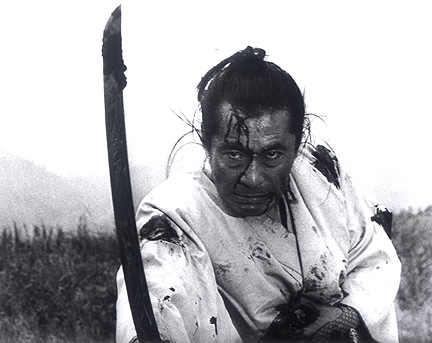
Here is that familiar face again, Toshiro Mifune, who has become one of my favorite actors of all time. Like Clint Eastwood, he is a man's man. His gruff face and mean scowl actually hide his brilliant acting abilities. It is interesting to watch him in a film not directed by Kurosawa, but in Samurai Rebellion he shows that he is his own man and once again is great in the lead role.
Samurai Rebellion is kind of a misleading title because at its core it is not really a samurai movie. It is a domestic drama that feels more Shakespearean than Japanese; it just so happens that the lead character is a samurai. The rebellion of the film refers to the lead characters' refusal to obey their lord's order and perhaps in a more worldly sense, it is a rebellion against traditional Japanese ideals.
Isaburo Sasahara (Mifune) is an aging samurai who has played by the rules all his life. He has served his lord faithfully, married into a good family and has put up with his nagging wife for twenty years. One day, the local magistrate informs him that the lord has banished his mistress from the castle. Lady Ichi, who has just borne the lord a son, attacked the lord in a rage after discovering his infidelity. The lord requests that Isaburo's son Yogoro marry Ichi. The Sasahara family initially refuses such a demanding request but reluctantly agree to it. Much to everyone's surprise, Yogoro and Ichi end up loving each other and make a perfect couple and soon have a daughter. The conflict of the film arises when the lord's eldest son and heir dies, leaving the son borne by Ichi to be the sole heir. Seeing as how it would be improper for the heir's mother to be married to a vassal, the lord requests that Ichi return back to the castle.
Enough is enough! Isaburo, Yogoro and Ichi can't believe this is happening. The audacity of the lord to force them to marry in the first place and then take her back on a whim after they've been happily married and have a child together is too much. Isaburo, who has been stuck in a loveless marriage for twenty years, cannot bear to see this injustice. He impores Yogoro and Ichi to never let go of each other, exclaiming that their love for each other has reinvigorated his life. The main focus of the film revolves around the negotiations between the Sasahara family and the lord's people regarding Ichi and the implications of their refusal to return her. This is the rebellion of the film.
This film is great all the way around. The acting and drama in the film is top notch, led by a powerful performance by Mifune as Isaburo. If you really think about it, the subject matter kind of makes this a chick flick. It places a lot of emphasis on emotions and the lead characters' thoughts and actions are pretty romantic if not heroic. It also carefully considers Ichi's feelings and opinions making her a strong and important female character, something that I don't really think I've seen in many samurai films. Don't worry though, you do get a chance to see sword fighting and Mifune kick ass, but that is almost an afterthought. The real action and turning points are in the drama.
Samurai Rebellion also boasts a terrific visual style. The double layered flashback scene where we find out why Ichi attacked the lord is unique and pretty modern and edgy, using jump cuts and freeze frames which is very out of line with how the rest of the film is shot. I also felt like the pictures (or compositions, what is the difference?) presented on screen were very ascetically pleasing.
Sorry, i'm exhausted right now so excuse me for the crappy entry, but I'll just close by saying I really enjoyed this film and thought it was great!
Grade: A
Wednesday, July 20, 2011
Day 91 - Le Doulos
Le Doulos (1962) directed by Jean-Pierre Melville
This is the second appearance on my blog for two French men, director Jean-Pierre Melville (Bob le Flambeur) and Jean-Paul Belmondo (Breathless) and both have grown on me immensely. I'll just start off by saying I really enjoyed this movie!
Doulos is the French word for hat, but to the world of cops and robbers it also means informant. Rappers would love this movie. It has it all, gangsters, tough guys, honor among thieves and of course the code of the street, "Stop snitching." The main focus of Le Doulos revolves around trying to decipher the actions and motivations of Silien (Belmondo) who seemingly snitches on his friend Maurice in a heist. Maurice is convinced Silien is an informant and must decide what to do about it. For his part Silien does some pretty unsavory stuff throughout the film to make us believe he is at least of questionable morals, but is he a snitch? Why does he do the things he does throughout the film? There are plot twists galore and the details of the plot are pretty intricate, but it is nowhere near the labyrinth that The Big Sleep is.
But like The Big Sleep, the whole point of this film is its style and watching Belmondo do his best Bogart. As I mentioned in my blog entry about Bob le Flambeur, Jean-Pierre Melville loved all things American and if Le Doulos wasn't in French you'd have no idea that it wasn't filmed in 1940's Hollywood. Everything about the movie screams classic noir. Shadow intensive cinematography, crime drama plot, the tough guys, sexy dames, and hard boiled dialogue? Check, check, check, check and check. The film is intentionally exaggerated in that regard. Everybody in the film wears a trench coat and fedora. These supposedly sophisticated Frenchies like their liquor hard, scotch and whiskey only please. Standard locations include sleazy bars and fancy night clubs. One scene uses so much shadow that it intentionally hides a character's face and since everyone wears a trench coat you don't really have any idea who it is.
This isn't just Melville's ode to his favorite gangster films though. It is also combines elements of the French New Wave that gives it a different kind of edge. One thing that I tried to focus on were any unorthodox scenes in terms of camera movement or editing. A scene that jumped out to me was when the police take Silien in for questioning. The camera is set up square in the middle of the room and swivels back and forth following the characters and their conversations. As Silien talks with the detective, rather than cut back and forth between the two the camera instead moves right to left to right to left (something that I noticed Woody Allen does a lot in his films). Then later in the scene the camera follows the detective as he makes a complete 360 degree circle around the room, then he paces back in the other direction and goes another 180 degrees. This entire interrogation scene is shot in a single take with no cuts or editing lasting over eight minutes! Great job by the actors and an even better job of directing by Melville.
The star of the film is Belmondo who just exudes cool from his pores, something I noticed right away from his role in Breathless. It is impossible to look at him and not see a little bit (or a lot) of Bogart in him. He's just fantastic.
I don't want to ruin the ending but the last ten minutes are great. The closing shot has so much style that it is almost a cliche and I mean that in the best possible way.
Note: One complaint someone might have about this film is that it is misogynistic and Belmondo has some really good slaps that would make Sean Connery blush. Melville would defend himself stating something to the effect, "I'm not misogynistic towards women, the characters are!"
Grade: A
Tuesday, July 19, 2011
Day 90 - Let the Right One In
Let the Right One In (2008) directed by Tomas Alfredson
Let the Right One In is a vampire movie that isn't really about vampires despite some pretty bloody scenes. It is a story about relationships and loneliness. It has more in common with a film like Lost in Translation than it does to Twilight in that regard despite its very Twilight-esqe moments. "I've been twelve for a long time," Eli says.
It also doesn't go into any of the vampire mythology, how Eli became a vampire or even really use the word vampire; it may be only mentioned once or twice. A vampire exists in this story and that's all you really need to know. Rather than focusing too heavily on typical vampire plot lines, the film instead digs deeper into what being a vampire means to a twelve year old girl. The beautiful part of the film is that it doesn't need any real explanation, it is told in a restrained and subtle manner that evokes emotion rather than intellectual analysis. Eli doesn't ever mutter, "It's so lonely being a vampire" or "I've finally found someone to connect with." Instead, you can sense these things through her actions, her expressions, her tender moments with Oskar.
The story begins with Oskar, a young twelve year old boy who is alone in the world. He has a distant relationship with his parents who are divorced. He is picked on mercilessly by bullies at school. He spends his nights sitting alone in the park by his apartment. There he meets a young girl named Eli who just moved in next door. She doesn't express it herself but you can sense she is alone in the world too. Obviously, she is a vampire.
If I had to categorize this film it would be an adolescent romance which is ironic considering it probably isn't suitable for kids, but take away the blood and dark ambiance and you get a touching and tender film that parents would gladly take their kids to. But the darkness works well for the film because of just how despairing the two kids' lives are. The darkness matches the loneliness in their hearts.
This film is well made all the way through, acting, directing, cinematography. The best part about the film is that it doesn't go about explaining itself, it allows things to develop slowly and lets the viewer soak everything in, the setting, the mood, the budding relationship between the two, Oskar's coming of age.
Let the Right One In is definitely a slow burner and those expecting Twilight will probably be disappointed, but those expecting an actually well made vampire romance should be delighted.
Grade: B+
Monday, July 18, 2011
Day 89 - Red Beard
Red Beard (1965) directed by Akira Kurosawa
For some reason I decided to start watching today's movie at 2:30 in the morning, so I probably wasn't in the best frame of mind to start watching a three hour movie. The first half of the movie was a bit of a struggle to sit through. I was kind of fidgety and had to pause it a couple times to go to the bathroom or find something to munch on. Kurosawa took his time setting everything up with no real central plot lines to focus on, but the pay off is worth it; the last half of the movie is some of the best stuff Kurosawa has ever filmed.
Red Beard would mark the end of the decades long sixteen film relationship between Kurosawa and Toshiro Mifune. How fitting that in their very first film together, Drunken Angel, Mifune would play the young disciple and in their last film, he would play the role of master. Surprisingly, Mifune's character, Dr. Niide, isn't even the main character of the film. The story is really about Noboru Yasumoto (Yuzo Kayama), a young doctor who is sent to a public clinic for the poor as part of his training. Noboru, arrogant and contemptuous, initially resists his assignment. He is on the fast track to becoming the shogun's personal doctor and feels working with these people is below him. He's received advanced medical training at a prestigious school and doesn't feel like he can learn anything from working at the clinic under "Red Beard" (Dr. Niide's nickname because of the reddish tint of his facial hair). The film's direction is obvious; Noboru does indeed have much to learn. Under the tutelage of the compassionate Dr. Niide and interactions with patients, Noboru learns the harsh realities of the real world and just how precious life is. Redemption, humanism, life lessons, etc etc. Thematically, Red Beard is typical and obvious. In fact, one of Kurosawa's biggest criticisms amongst haters was that he was too naive, too sentimental in his works. (As much as I appreciated Ikiru, I thought he laid the sentiment on pretty thick.) But why is that such a bad thing? Why can't people just watch movies to feel uplifted and think that maybe life is meaningful?
Structurally the film can be divided into three or four chapters, each involving a different patient and Noboru's interactions with them. Through each interaction, Noboru learns a little more about not only what it takes to be a doctor but a human as well. Part of my restlessness throughout the beginning of the film was the fragmented stories and lack of a central plot, but upon further reflection I can see why the film was made this way. The drama of the film can only be told through these interactions, Noboru's growth can only be shown through what he learns from these patients. Each story is given ample time to develop, even though they may not have much relevance to the overall plot of the film, which may or may not turn some people off. However, that does not make any of the stories less compelling and more importantly, any less relevant to Noboru.
The last act of the film is a revelation in itself. It is touching and endearing, heart breaking and heart warming. It involves the story of Otoyo, a young girl rescued from a brothel. (This part of the film is actually pretty hilarious as it involves Dr. Niide unleashing the inner Mifune as he beats up a gang. As the scene started to materialize, I said aloud, "You can't f*ck with Yojimbo, man!") Dr. Niide gives Otoyo to Noboru as his first patient. The two broken characters end up learning from each other and ultimately heal each other. Otoyo, who has only known bad people in her life, slowly learns to trust and care for others. She ends up meeting a seven year old thief and this side story almost brought me to tears.
Visually Red Beard is a very striking film, something you wouldn't really expect from this kind of movie. Kurosawa shoots some interesting pictures. Little details like the spacing between characters on screen can have such a strange effect on a scene. In one scene, Noboru is on the far left of the screen while a woman is on the far right. In a widescreen picture the space between them looks enormous. They have just met each other and are strangers, but watch closely as she reveals more about herself bringing her closer to him. The spacing on screen is directly correlated to the drama in the story. One shot involves Otoyo hiding in a darkened corner with only her eyes visible, as if the entire screen were a ninja's mask. Yet another shot fills up the screen with multiple layers, almost as if shooting two shots in one. It involves Otoyo secretly meeting the young boy in a yard with a bunch of sheets hanging on clotheslines. They are situated in the top half of the screen partially blocked by sheets yet in plain view to the viewer. In the bottom of the screen, Noboru and a nurse secretly eavesdrop on their conversation behind a different row of sheets. It kind of reminded me of that scene in Citizen Kane where there's an interior scene and an exterior scene going on at the same time in the window. Perhaps the best shot of the entire film is also at the core of its biggest moment, so I don't want it away, but pay close attention to the camera's effortless movement and think just how complex it must have been to plan it. It would be very easy to miss given how emotional the scene is, but that is what made Kurosawa so great, he paid attention to every last detail.
Mifune, as always, is great as Dr. Niide. Interestingly though, this film would cause tensions between Kurosawa and his star actor. Red Beard took two years to film and during this time Mifune had to maintain his natural beard which made it impossible for him to star in any other movies at the time, causing some financial strain for the actor. Also, the script writer of the film had mentioned to Kurosawa that Mifune played the part "all wrong." Despite their long history with each other and the fact that Mifune's portrayal earned him universal praise, the script writer's comment caused Kurosawa to question Mifune's abilities for the first time. Perhaps it was just coincidence, but the two never worked together again, marking the end of one of the best director-actor collaborations in the history of cinema.
Kayama as the young Noboru is fine, though it is almost impossible not to only focus on Mifune whenever he is on screen. Not only does he have such immense screen presence but Mifune actually looks physically much bigger than Kayama. I was very impressed by the young girl who played Otoyo, who is practically the main character in the third act and handled her scenes very well.
Red Beard is wonderfully acted and directed. The last half of the movie might be the most touching and emotional work of Kurosawa's career. Yes, its message is simple, maybe even naive as his critics may say, but so what? Since when did humanism become a source for scorn and when did nihilism and negativity dictate how people should perceive life and what we should expect of our stories about it?
Grade: A-
Sunday, July 17, 2011
Day 88 - Harry Potter and the Deathly Hallows Part 2
Harry Potter and the Deathly Hallows Part 2 (2011) directed by David Yates
I'll be honest. I never really got into Harry Potter. That's not to say I didn't enjoy the films but I never had a particular attachment to them. For what it's worth, I never read the books which I heard is a requirement to love these films, but that's kind of a ridiculous argument. Guess what, I never read Lord of the Rings either and I really liked those movies. I just found it hard to really get into the Harry Potter films, but I will say that for the most part I have enjoyed the series even though I can barely remember any of them. (I distinctly remember disliking at least one of them, probably The Half Blood Prince, but it's all a blur to me now.) It's hard to believe that The Sorcerer's Stone came out in 2001 when Daniel Radcliffe was just eleven years old. We've watched him grow up before our eyes and ten years and seven films later he's matching wits and wands with Ralph Fiennes as a full grown adult in the last installment of the most successful movie franchise ever. The Deathly Hallows Part 2 probably does the best it can do in closing out the series respectfully, perhaps even impressively. Certainly as the last film it has a lot to live up to and I think it does a good enough job.
Given that the series has spanned eight films over ten years and that I don't think I've ever seen any individual one more than once, you can excuse me for not being up to date on all the matters of Hogwarts. There are a lot of characters to keep up with and lots of subplots that I needed reminding of. I'm sure there were parts of Deathly Hallows 2 I should have known better if only the other movies were a little fresher in my mind. Not that the movie is a complete puzzle, it's pretty clear what Harry and company must do and I just took the minute details as part of the ambiance of the film. I may not know who this flying ghost is, but I don't really have to, I just know that she exists in the world of Hogwarts and is one of the little quirks I should come to expect. I suppose that was the huge appeal to the Harry Potter books. In them, J.K. Rowling created a magical little world with its own mythology and lexicon. I'd imagine half the fun of the books was just learning the mythology.
I won't divulge into details but here is a brief rundown. Harry, Ron and Hermione must find and destroy the rest of the horcruxes. There is an epic battle between the forces of good and evil at Hogwarts and of course the final showdown between Harry and Voldemort that all the films have been leading up to. So how does the film handle all this? Slowly but surely. I wouldn't really call this a rip roaring action adventure, there is a good deal of exposition involved, but the action sequences are interspaced nicely throughout. I will say though that as grandiose as the final showdown may look, I feel it lacks the emotional punch required to make you care for it. We see familiar faces fighting for the good guys but they aren't given much to do other than wave their wands. We see bodies lying everywhere but without proper development to the characters or scene, you're more like, "Oh" than "Aw." Of course this film isn't required to build that much up. It is the culmination of all the previous films which were developed solely for this one, so we were already supposed to care for what happens because of those movies. Obviously nobody is going to watch Deathly Hallows 2 as their very first Harry Potter film, but if you were never particularly attached to the other films, it might be hard for you to suddenly get up for this one.
Cinematically speaking, the film is dark and moody and has the appropriate cinematography to match. I've always felt that the Harry Potter movies were well shot. I've never really been impressed by Daniel Radcliffe, who is good but not great, though to be fair Harry Potter as a character is a little bland. He is the hero but is he really that interesting? Compare that to his supporting cast who cover a greater range. There is Ralph Fiennes as his evil foil Voldemort who relishes in his role as the bad guy. Alan Rickman as Snape wasn't given much to do last film and even here he shows up in limited capacity, but his mere presence on screen overshadows anything Radcliffe does. I must say that I am a huge fan of Helena Bonham Cater who plays the bewitching Bellatrix. She's been stellar in her past several movies including The King's Speech, Alice in Wonderland and Sweeny Todd.
I think between Harry, Ron and Hermione, Emma Watson has by far the biggest potential. It goes to show just how much growth and experience pays off because I thought she was the pretty bad in the first couple ones, now I think she has a chance to be a real star if she choses to. I think she has stated she'd like to go to college after Harry Potter and it is easy to forget that she, like Radcliffe and Rupert Grint, was thrust into basically a ten year role at such young a young age. Perhaps it was never her childhood dream to become an actress? As far as Radcliffe himself? I'd like to see him do well, but I think he will probably suffer after this. He is just way too recognizable as Harry Potter. Just ask Mark Hamill about life after Star Wars.
Grade: B
Saturday, July 16, 2011
Day 87 - A Hard Day's Night
A Hard Day's Night (1964) directed by Richard Lester
Light hearted whimsical fun, filled with humor, energy and of course great music by the one and only Beatles. From the opening sequence of John, Paul, George and Ringo running away from crazed fans you can get a feel that you're going to watch something special. A Hard Day's Night is a mockumentary about the famous band during the height of Beatlemania. The "behind the scenes" looks are filled with an off beat humor that reminded me a bit of This is Spinal Tap, another famed mocumentary about a rock band.
I loved the banter between the four Beatles which is whimsical and humorous.
George: Ah, you have an inferiority complex, you have.
Ringo: Yeah I know, that's why I play the drums - it's me active compensatory factor.
And their interactions with the media.
Reporter: Has success changed your life?
George (in a total deadpan expression): Yes.
If I had to describe what this movie is about in one word, it'd be freedom. The Beatles have become trapped by their fame, by the crazed fans and the pressures of their manager and director. They are set free in the scenes when the music plays where they flee from fans, run loose frolicking in a field, or just get behind their instruments and jam. This was set in the heyday of the free loving hippie liberation movement during the 1960's and rock and roll music was the soundtrack to the era.
The film is really well made, intercutting the behind the scenes documentary feel with moving action shots following the Beatles' hectic lives and of course the music. It is part documentary, comedy, music video, concert film and 100% good fun. All the Beatles have great one liners and each have their moments to shine. I really loved Paul's grandfather who is just hilarious. There isn't much plot going on, it just chronicles a couple days in the lives of the most famous band in the world. Certain situations are obviously absurd, but that is sort of the point. The Beatles were larger than life in that every little step they took was magnified to ridiculous proportions. Every little thing they did was made into an event, a feeling that this film captures perfectly.
Grade: A-
Subscribe to:
Posts (Atom)