Vengeance (2009) directed by Johnnie To
"What does revenge mean when you've forgotten everything?"
Vengeance begins with a brutal hit on a family. A man and his two children are shot dead with the wife critically injured. The woman's father, Costello, arrives from Paris to Macau in light of the shocking news. Hanging on life support the woman is able to relay one simple message to her father, "Avenge me." And thus begins a rather fantastic blend of revenge drama with Hong Kong style action and flare. Mix in a little bit of Memento and a remarkable visual style and you get Vengeance.
I mention Memento because Costello's memory is fading, so it is important that he avenge his daughter's family before he forgets not just who he must kill but also why. A stranger to Macau, he enlists the help of a trio of hit men who he happens to cross paths with. He takes a picture of his allies to remind him of who they are. The four men bond together. There is a language barrier between them. He is French and they are Chinese and must communicate to each other in broken English, but there is an unspoken understanding between them. They know what must be done, they feel his pain.
This is a really great film, unique and stylish, thrilling and at times moving. Director Johnnie To has been around Hong Kong cinema for over two decades and I'm sure I've seen some of his movies as a kid, but Vengeance is the first I've seen as an adult. If this film is any indication of his talents then I'll gladly dig a little deeper into his filmography.
There are a couple really great scenes. One is so beautifully choreographed that if you stopped to think for a second you'd realize how preposterous the set up is, but you don't really care because it looks so damn cool. In it, the trio of hit men are surrounded in a open junkyard by their enemies. In a widescreen shot you can see the bad guys circling in on their location crouching behind big bundles of scraps rolling forward like gigantic dice. The wind is the equivalent of a category 3 hurricane as debris and paper fly around everywhere. It is really quite the scene.
Another visually compelling shot is Costello lost in streets of Hong Kong in the rain. He holds up his polaroids of his friends trying to match the faces in the pictures with anyone on the street. The combination of the neon signs with the gloomy rain makes for such an interesting look.
I really liked Vengeance so a special thanks to my friend Zach for recommending it to me, even though he may or may not read this blog!
Grade: A
Friday, July 29, 2011
Thursday, July 28, 2011
Day 99 - Blue Velvet
Blue Velvet (1986) directed by David Lynch
I am not really familiar with David Lynch other than The Elephant Man and I actually didn't even realize he directed that. I knew Lynch's name through Mulholland Drive and Blue Velvet which I have heard really good things.
I liked Blue Velvet but I didn't love it. There are things I found really intriguing and other things I found head scratching. I guess I don't really understand the juxtaposition between the darkness of the sexual encounters with the almost campy setting of the film. Is there a point in contrasting the twisted sadomasochism with this Pleasantville-style suburban utopia? That there are dark secrets underneath the surface? Okay that I can get with, but it just feels much more self important than it really is and creates an odd balance to the film.
The film opens with Jeffery (Kyle MacLachlan) returning home from college to visit his father in the hospital. On the way home he discovers a severed ear in a field. His curiosity leads him to discovering a dark and twisted underworld hidden beneath the surface of seemingly perfect suburban life. It is highlighted by the intensely sadomasochist sexuality of Dorothy (Isabella Rossellini) and her encounters with both Frank (Dennis Hopper) and Jeffery.
I appreciated how well shot the film is. The very opening sequence where Jeffery's father has a heart attack is really well shot (sorry I can't really describe it any other way than that). The whole film is full of imagery and symbolism.
Reading more about Lynch and Blue Velvet on Wikipedia, one of Lynch's common motifs is this hidden underworld. Jeffery even says something to that effect in the film, stating that he is seeing something that was always hidden. I suppose the point is that there is no such thing as perfect, that behind the doors there is something dark hidden inside. However, I feel like Lynch could have went all out on the sexuality and violence rather than mask it behind the rest of the film to make it really powerful.
Dennis Hopper as Frank is so insane that it is hard to really judge his performance. I thought he was great, but it made me wonder if I was supposed to understand more about his character other than that he is a complete psycho. Was I supposed to read more into it than that?
I liked Blue Velvet. It had a lot of good parts to it and I liked how strange it was, but at the same time I felt the strangeness might have actually detracted a little from the overall effect.
Grade: B
Wednesday, July 27, 2011
Day 98 - Vivre Sa Vie (My Life to Live)
Vivre Sa Vie (My Life to Live) (1962) directed by Jean-Luc Godard
Of the French New Wave directors I have watched, Godard (Breathless) seems to be the most unique and innovative. You know you are watching more than just a film when you see his pictures, you are experiencing art. I can't tell you exactly what makes Vivre Sa Vie great other than it is different, different in the way it is shot, different in the way it is told, different in the way it feels. And if this were shot in smell-o-vision 4D, it'd probably smell a little funky too.
In short, Vivre Sa Vie is about a young woman named Nana who aspires to become an actress but instead falls into prostitution. The film is broken down into twelve chapters, each one digging deeper into Nana's descent into this underworld. She discusses matters with her ex-husband. She works at the record store. She has trouble paying rent. She takes in her first client. She finds herself a pimp. There is even a chapter devoted to explaining the rules and customs of prostitution. Further and further Nana spirals into the abyss.
Stylistically the film is quite unique. The very first glimpse of Nana is in the opening credits where we see an extreme close up of her face, in a cross between mug shot and magazine cover. Anna Karina, then Godard's wife, is featured prominently like a model, her meticulously shaped hair, her flawless skin and those deep penetrating eyes.
Then as the film begins for real, we no longer see her close up but see her from the back facing away from the camera. An entire conversation is shot only seeing the back of their heads. We can steal occasional glimpses of their faces through the mirror. What is Godard trying to tell the viewer in this shot? Perhaps that we can observe Nana from afar but will not be able to read her? Perhaps it is a metaphor for her prostitution, we get this impersonal glance at her, but nothing more. Or maybe Godard just wanted to be different. Regardless of how you read it, immediately we can see that this film will be different and it is. Like Breathless, Vivre Sa Vie sort of has a documentary feel, thanks to a hand held camera rather than the traditional mounted one. This camera follows Nana around throughout this journey and we are treated to some great shots. There is this shot of her smoking a cigarette while with a customer. There is the scene when a man smokes and they kiss and she exhales it. There is the shot of her in the theater watching The Passion of Joan of Arc.
The film is shot in crisp black and white. Many people who say they hate black and white don't realize just how beautiful black and white photography can be and often times it looks much better than color. Anna Karina's face literally glows on screen in some instances, an effect that can only be done in black and white.
Another distinct feature of this film is its use of music. The main score recurs over and over throughout. It is a powerful and tragic sounding melody that seems to be used to highlight the emotion of a scene.
A couple scenes that popped out to me is when Nana plays the jukebox and starts to dance. She looks so sexy and she has so much energy and joy in her, the only time in the whole film where it looks like she is enjoying herself. Another scene is when her pimp gives a detailed run down of how prostitutes work, how much they should charge, how often they change sheets in the hotel rooms, how many customers they average a day, etc.
I hate to admit it, but this film may just be too smart for me. Reading critics' discussion of this film only further proves that I am just an amateur at best, not just as a critic but as a writer as well. They go into some really heavy stuff that I'm still trying to wrap my brain around. I've watched the conversation between Nana and the philosopher twice now and I still don't really get what they are talking about. I'll gladly give a dollar to anyone who can explain it to me like an eight year old.
Yet despite not understanding themes and metaphors and interpreting scenes wrong and just flat out not getting it, I still somehow found enjoyment in the film. I was instantly drawn to Nana's character and her plight. I was captivated by the visual style and accompanying music. I appreciated the intellectual discourse even though I wasn't a part of it.
Grade: B+
Tuesday, July 26, 2011
Day 97 - Pale Flower
Pale Flower (1964) directed by Masahiro Shinoda
The film opens with the lead character Muraki narrating. He just finished serving prison time for killing a man, but he wonders, "What's so wrong with killing one of these stupid animals?" He's an old time yakuza hit man with seemingly no meaning to life. The only thrill he gets is from gambling, but even then he doesn't reveal any emotion. At the gambling house he meets a young woman named Saeko who is also there to feel alive. She is bored with life and is looking to feel something, anything. The difference between him and her is that while she is searching for something, he already knows there is nothing out there. Life, he says in more or less words, is stupid.
Pale Flower is dark and moody. It explores these two nihilistic characters' quest for fulfillment and takes the viewer to the darkest corners of their lives. This is perhaps both a strength and weakness to the film. It allows us to view the emptiness of their lives, but it also means a sort of emptiness to the film as well. Despair and soul sapping moroseness this film has, deep characterization or plot it does not. It is all about the feel, the style, the ambiance and little to do with much else.
I sort of need to watch this film again to talk about it fairly because I feel I missed a lot of the stuff between the lines. If you watch Pale Flower at face value, you will not get much out of it. The characters are not particularly well developed and the plot doesn't really offer anything exciting. Much of the feel is in the visual style and tone and if you're not receptive to it you'll miss a lot of the feeling of the film.
Visually the movie is well shot and is obviously heavily influenced by film noir. I seem to have watched a ton of these types of movies lately because I've been noticing it a lot. There are two scenes that really popped out to me. One is the dream sequence that feels so surreal. The other is the ending in the restaurant.
Overall I have a sort of mixed reaction to the film and most of it is my fault for being so distracted when I watched it. Nearly every review I have read of Pale Flower mentions a bunch of stuff that I just flat out didn't get or bothered to think about. But I will say that having watched the film and having a brief understanding of it, I feel like it sort of misses the boat. The main problem is that we never get to really know Muraki and Saeko so it becomes difficult to have any connection with them. Perhaps that is the point though, their existence is so futile that what is there to even know?
Grade: B-
Monday, July 25, 2011
Day 96 - The Thief of Bagdad
The Thief of Bagdad (1940) directed by Michael Powell, Ludwig Berger, Tim Whelan and a a couple others
While watching this film I was reminded a bit of three films, the first being The Adventures of Robin Hood. Both are big fairy tale adventures shot in Technicolor. Both fill the viewer with wonder and excitement, reminding them of when their parents told them bed time stories. They both have that cheesy kind of play acting that seems almost amateur yet innocent and sweet. It doesn't matter if they are not particularly well acted films, you are captivated by the timeless storytelling and the adventure.
Perhaps the film that The Thief of Bagdad has most in common with cinematically is The Wizard of Oz, another Technicolor adventure. Both share a vivid fantasy element unlike any other movie at the time and employed state of the art special effects, particularly The Thief of Bagdad. The effects may seem crude by today's standards, but no other film at the time was doing this kind of stuff and they are still pretty impressive today.
The other film is obviously Disney's Aladdin, as both are based from the tales of One Thousand and One Nights. Many of the plot points and characters are the same. The bad guy in both films is named Jafar and there is a thief named Abu. There is even a genie and a flying carpet.
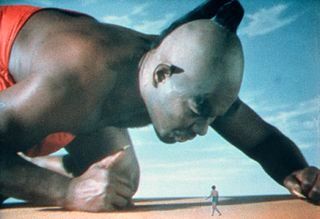
What I liked most about The Thief of Bagdad was just how magical the story seemed. This was accentuated by the special effects. There is the sultan's toy room and the wind up flying horse, a flying carpet, an evil spell turning a boy into a dog. Perhaps the most pronounced effect is the giant genie. Each episode in the film is highlighted by different special effects. It seemed like one scene after another.
The film doesn't necessarily have one singular plot, it is a series of episodes that reads like an adventure story. The king of Bagdad Ahmad is tricked by his Grand Vizer Jaffar in a manner that has Ahmad on the run deposed of his title. He meets a young thief named Abu and they go on a series of adventures together, all leading of course to Ahmad retaking his throne. Ahmad's driving force is his unrequited love for a princess. There are an array of settings for the adventures, the streets of a city, a storm at sea, a scary cave with giant spiders, the grand palace.
This also marks the third film that Michael Powell has directed that I have seen (The Red Shoes, Peeping Tom) and I've enjoyed all of them, although he was just one of several directors attached to this film. Before I started watching all these movies I had never even heard of him, so I guess I'm learning a little something!
A true test for a film like The Thief of Bagdad is to see how kids react to it. With all their distractions and fidgety ways, kids these days would tend to balk at the idea of an older movie, but my guess is that they'd find this film as fascinating as any Disney cartoon. Kids like adventure in any form.
Grade: A-
Sunday, July 24, 2011
Day 95 - Dr. Strangelove or How I Learned to Stop Worrying and Love the Bomb
Dr. Strangelove or How I Learned to Stop Worrying and Love the Bomb (1964) directed by Stanley Kubrick
I kind of dread watching these super famous movies sometimes because you have to invest so much energy to watch them. That is why I held off so long to watch Lawrence of Arabia and why I still haven't seen some other classics like Gone with the Wind. Also for the purpose of this blog, it is hard to write about a film that has been talked about to death by people much smarter than me, but here I go...
To fully appreciate Dr. Strangelove, you have to understand the context in which it was made. It was filmed during the heart of the Cold War where fear of nuclear bombs was constant. It is a perfect satire to this whole era. While the Cold War is long over and we don't have to worry about communists anymore, I think there will always be a fear of nuclear weapons. This will always make Dr. Strangelove relevant even as memories of the Cold War fades away from our social consciousness.
Above all, this film is really funny. It is highlighted by Peter Sellers' triple performance as Mandrake, the President and Dr. Strangelove, but the supporting cast is great too. There is Sterling Hayden as the insane General Ripper, Slim Pickens as Major Kong and George C. Scott as General Turgidson. It is hard to pinpoint a single character but I guess my favorite would be Mandrake. There is just something really funny about him. Maybe it is his British accent or his thick sophisticated mustache, but more likely in his nervous interactions with General Ripper. You can tell he's thinking "WTF?" when Ripper explains his theory on bodily fluids, but can't really say anything because Ripper is clearly insane. He is stuck in an impossible situation and it's just so comical.
Sellers is also great as the President. His mild manner delivery of absurd lines like, "There's no fighting in the war room!" are gold. This role kind of reminded me a lot of Gene Wilder, and that is a compliment in the biggest way.
Scott as Turgidson is pretty hilarious too. He is so over the top. I like how he's always pointing at the map of Russia. "The Big Board!" I laughed hard when he's describing the skills of his pilots proudly, only to realize that it probably means the end of the world.
Speaking of the War Room, the whole thing looks preposterous. It is just a giant empty room with a table in the middle. The Big Board that Turgidson is always worried about spies seeing is just a giant map of Russia. There is even a buffet in the back.
Underlining this comedy is an actual tension and suspense. I had no idea how it was going to end, nor how it should end. Would Genearl Kong's bomber hit his target and trigger the end of the world?
I think the film works perfectly for what it wants to accomplish. It works as a satire and as a suspense. It also goes to show that maybe machines won't be the end of the the world, but rather humanity's own stupidity.
Grade: A
Saturday, July 23, 2011
Day 94 - Friends With Benefits
Friends With Benefits (2011) directed by Will Gluck
Can two people have sexual relations and still be just friends? It would seem like the answer is obviously no, which is why it makes for such an easy premise for a romantic comedy. Undoubtedly Friends With Benefits will draw comparisons to No Strings Attached, a similarly themed rom-com released earlier this year, but they are actually pretty different. While I enjoyed No Strings, Friends is consistently more funny and has more heart. Also there seems to be a genuine chemistry between Mila Kunis and Justin Timberlake, while anything Ashton Kutcher is in is in serious danger of totally sucking.
I won't bother dealing with the plot, that much should already be obvious. Two friends start to have casual sex with no attachments. Feelings, complications, inevitable fight and reconciliation with a few laughs and tears along the way. What is most noteworthy about this film is that it showcases Kunis and Timberlake in the lead roles and they shine. They are funny and charming and have the superstar good looks to back it up. Timberlake has gone a long way from being the lead singer of a boy band to a legitimate actor. He faced immense pressure to not screw up The Social Network but he turned out to be just fine. I think he'll end up alright given the right kind of roles. Maybe one day we will think of Timberlake as our generation's Frank Sinatra. Kunis is also proving to be a good actress with her dramatic breakout in Black Swan. Here she tackles comedy, a genre she is perfectly comfortable with. The two work great together, helped along with a smart and funny script.
The film is also highlighted by a great supporting cast. I wish Andy Sandberg and Emma Stone played bigger roles because their little scenes were really funny. Woody Harrelson is hilarious as a flamboyantly gay friend of Timberlake's character.
The keys to successful rom-coms? 1) Chemistry between the leads. 2) Be legitimately funny. 3) Not be overly romantic as to not scare away the guys from taking the ladies out to see it. That is all people really expect out of these movies. As simple as that formula sounds, so many of them fail in one way or another. I'm happy to report Friends With Benefits doesn't.
Finally, to answer that question in the beginning, in my humble opinion I think two people can have a sexual relationship and still be friends, but it probably means that they weren't really close friends to begin with. When it is two best friends then that is where it gets too complicated, at least that is what the movies tell me.
Grade: B
Subscribe to:
Posts (Atom)