Blood Simple (1984) directed by Joel Coen
I didn't realize this but the Coen Brothers didn't work as a director tag team until 2004 with The Ladykillers. Prior to that Joel got director credit, Ethan produced and both shared the writing duties, although I get the impression that the titles were just a formality and that both had their say behind the camera. The Coen Brothers debut film was Blood Simple, a dark film noir that explores several themes that are prevalent in their later films, namely violence and a comedy of mishaps and misunderstanding, to a lesser extent chance and fate.
Blood Simple tells the story of a man who hires someone to kill his wife and her lover, but things never go as smoothly as planned. Much of the film revolves around each of the characters knowing something that another does not. Watching the movie unfold, we see and know everything that is going on which makes the characters' actions seem all the more maddening and tragic. For instance, in a prolonged scene in the middle there is a misunderstanding between the two lovers as the man thinks she has done something that she hasn't. He takes measures in covering for her except that she has no idea what is going on. When they meet again, it would be so easy for him to ask her, "Did you do it?" or "Why did you do it?" or make any reference to "it." Instead, he is vague and ambiguous and distanced from her driving them apart. She in turn begins to suspect that he has been up to something and it's all so frustrating to watch because it's just one big misunderstanding.
I really liked how the movie flowed. It sort of goes by slowly and has these sudden bursts of violence and moments of shock. I like that it takes its time and doesn't rush anything and the ending has so much suspense and is so well shot. I loved it.
Watching this film was sort of like watching those old noir films with the shady underhanded characters, the plot of murder, affair, and intrigue and the incredibly dark setting. The four main characters are the sleazy bar owner, the cheating wife, the jealous lover and the crooked private investigator. Everyone was great in their roles.
The film has a pretty unique style; it's almost as if the Coen brothers wanted you to know how bold they are. The camera moves quite a bit and uses strange camera angles. The phrase "self-conscious" is used a lot in describing Blood Simple. I'm not really sure what that means; perhaps it means that it is well aware of how different it feels and wants you to come along for the ride and embrace it.
Grade: A-
Sunday, August 14, 2011
Saturday, August 13, 2011
Day 115 - 30 Minutes or Less
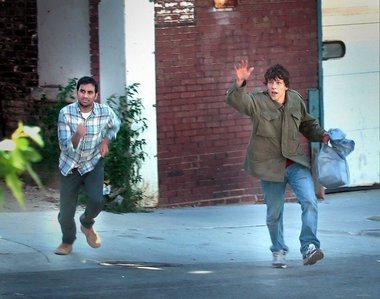
30 Minutes or Less (2011) directed by Ruben Fleischer
How do you compare movies across genres? You might argue that Anchorman: The Legend of Ron Burgundy is a better comedy than The King's Speech is a drama, but does that mean it is a better movie? It's really hard to say. I think comedies are the most difficult movies to gauge because you go into them with completely different expectations than, say, an Oscar nominated drama. For instance, I gave critically acclaimed Winter's Bone and dirty comedy Horrible Bosses both B+'s, but isn't it obvious Winter's Bone is a "better" movie? Well, I suppose it depends on what you're looking for.
Comedies are tricky because you really only expect one thing out of them and that is to laugh. So you ask yourself the question, "Is this movie funny?" and if it is, it is automatically more fulfilling than most other movies no matter how absurd or stupid the plot may be. Of course the really good comedies will give you something else; they'll surprise you with moments of tenderness or exceptionally sharp wit or cleverness. Or they are so exceptionally funny that tears stream down your cheeks.
Since most comedies are at least a little bit funny, it is easy to assume they have done their job and inflate their grades. I am probably a little easy on them, like the mindless action flick, to a fault. By the same token, I find that I am also particularly hard on even the really good ones because, well, they're just comedies, right? (It is very rare for me to give a comedy an A.) What ends up happening is an elevated floor and a glass ceiling to the grades so most comedies get bunched up in the middle.
All of this is just filler material of course as there really isn't anything notable to say about 30 Minutes or Less. It is an obviously stupid film, but it does get in its moments of laughs. By nature of its sheer retardation and pretty awful acting it automatically limits what grade is possible for it. I'm still not sure how I feel about Jesse Eisenberg; he was good in Zombieland and The Social Network but can he play anything else but the awkward slacker type? Aziz Ansari is a funny comedian, but he is not a great actor. I've never been a huge fan of Danny McBride; he has his hits but also a lot of misses.
If you want to dig a little deeper, this film does deal with issues of friendship. Two sets of friends, Eisenberg/Ansari and McBride/Swardson both bicker throughout the film but when the going gets tough, they pull through for each other.
Grade: C
Friday, August 12, 2011
Day 114 - Nosferatu
Nosferatu (1922) directed by F.W. Murnau
As a kid, my favorite movie genre must have been anything with Chinese vampires. If I remember correctly, these movies were a combination of horror, martial arts, comedy, action and adventure. These elements varied from film to film, but the one constant were those scary zombie looking vampires. Before teenage girls wanted to hold hands and frolic in flowerbeds with them, people of all ages were terrified of vampires. They're undead creatures that want to suck your blood for goodness sakes. You should be running from them, not wanting to trade spit with them. In Chinese folklore, they aren't the beautiful shimmering models portrayed in Twilight, but hideous and ominous monsters out for blood. Somewhere along the way we forgot that vampires once captured our fears, not our hearts.
Nosferatu was the first, albeit unofficial, film adaptation of Bram Stoker's Dracula and played an important role in popularizing vampires in cinema, if not our minds. Here we see vampires for what they were all along, monsters. Count Orlock is more creature than man, with pointy ears, elongated claws and rodent like front teeth. The first time he appears on screen you don't really jump back in fright (this isn't that type of film) but feel his ominous presence. His presence is felt throughout the entire film even in the scenes he isn't there. In fact, we don't even see him until fifteen minutes in and the narrative jumps around quite a bit away from him, yet you can sense him lurking somewhere, in the shadows, in their dreams, anywhere, everywhere. And that is the key in making a memorable character, particularly a villain.
A mysterious buyer from Transylvania expresses interest in an abandoned house. The real estate people send their man Hutter to go out there to meet him. The road is dark and long. The local tavern falls into a deep silence when he reveals he's meeting a Count Orlock. His guides refuse to go further down the road this late at night. Something is clearly up and we haven't even caught a glimpse of the vampire yet. He commands your attention both on and off screen. The two have dinner together, Hutter accidentally cuts his finger, blood oozes out, Orlock's eyes widen, he tries to get a taste, the title card reads: "Blood! Your precious blood!" (What do you imagine would be the topic of discussion after that? Would it be awkward to cut your dinner short at that point?) Later, Orlock sees a picture of Hutter's wife in a pocket watch. "Is this your wife? What a lovely throat." Hutter's suspicions grow, so he snoops around and sees a coffin. I think the general rule is that you have to open any strange coffin you see. Yep, it's Orlock in there alright, sleeping in the middle of the day. Vampire confirmed. There is still the matter of him moving to this abandoned house and of course the fact that Hutter and his wife live directly across from it. Yes, Hutter's wife with her lovely throat.
The previous silent films I've watched (Modern Times, City Lights, The General) have all been comedies which I think is the best medium for silent pictures. You can see a guy slipping on a banana peel or getting pied in the face and you laugh; there is no explanation needed. Nosferatu is a drama/horror which is more difficult to conceptualize with only images but I feel like it does it pretty well. The film is not particularly scary, especially by today's standards, but it does create visually striking images. Count Orlock looks dark and creepy; he looks like a villain. (The scene in the ship where he pops straight up out of his coffin is pretty freaky.) Like Fritz Lang's M, the film makes heavy use of shadows (both films being influenced by German Expressionism). It even has rudimentary special effects where Orlock vanishes into thin air. The film creates an eerie atmosphere that you can absorb visually rather than through its plot.
I can appreciate Nosferatu for its historical significance, even for moments of entertainment, but I have to admit that I was somewhat ambivalent overall. It just didn't excite me very much. This was definitely more of an atmosphere kind of movie; I'm sure if seen at the right time and in the right frame of mind, it can be really spooky, but I found myself more amused than terrified. It is easy to look back with fond memories at a film almost ninety years old, but seeing Count Orlock for the first time must have been quite the sight.
Grade: B-
Thursday, August 11, 2011
Day 113 - Star 80
Star 80 (1983) directed by Bob Fosse
Today is my birthday, so I decided to pick a movie made in the same year I was born and I stumbled upon this disturbing little gem. Wow, was 1983 really 28 years ago?
I've never heard of Star 80 before so I assumed it probably sucked, but was intrigued by the description: the true story of Playboy Playmate of the year Dorothy Stratten who was murdered by her estranged husband Paul Snider. I decided to give it a shot and was hooked five minutes in. This is a really really good movie.
There are no mysteries in this film; it begins with the ending, Paul Snider covered in blood and Dorothy Stratten laying dead on the floor. The film is shown in a series of flashbacks; how Paul met Dorothy, her rise to fame, his growing instability and paranoia, all events leading to the tragic end. And in case you've forgotten, the film will remind you where it's all headed by weaving in the blood soaked ending throughout. Knowing the ending to the film makes all the events even more tragic. We see Dorothy's sweet innocence, her youth and nativity, her stunning beauty and we are disheartened to know that it does not end well for her and it comes in the most brutal way imaginable.
While watching Star 80 I was immediately reminded of a criminally underrated Martin Scorcese film, The King of Comedy. Both films share many of the same themes of an outsider trying to get in, desperation, rejection and isolation. Paul, a small time salesman, hustler and pimp discovers Dorothy and immediately takes advantage of her nativity and insecurity. The two become romantically involved and he convinces her to send photos to Playboy. She is his ticket to the big time, to his dreams of riches and fame. As you can guess, she becomes famous and he desperately tries to hold on to her coattails. Watching him try to rub elbows with the likes of Hugh Hefner and Hollywood stars makes you cringe in embarrassment. It is clear that Dorothy doesn't really need Paul anymore and we can see him slowly losing his grip on her and ultimately himself.
Eric Roberts' portrayal of Paul Snider is disturbing to say the least. He hits all the notes so well; paranoia, jealousy, insanity, and rage. He goes from slick con man who has this gorgeous girl under his thumb to a desperate man who's lost his grip on reality. He is almost a sympathetic character until you remember that he kills her, but even then maybe you sort of understand where he's coming from.
Dorothy is played by Mariel Hemingway, who I remember from Manhattan. She exudes a sweet innocence that makes her fate all the more tragic. (It's all in her wide puppy eyes.) She is a victim even before she gets killed. You can see it a mile away, marrying a much older man at eighteen, taken advantage of and manipulated. She never even realizes what a psychopath Paul is. It is easy to forget that Dorothy was only twenty years old when she died.
Star 80 is disturbing to think about let alone watch yet you feel compelled to see it all the way through. There are no moments to relax for the viewer; the build up to the inevitable makes the final moments drag on in despair, almost as if her death would be a relief. What a horrible thing to feel.
Grade: A-
Wednesday, August 10, 2011
Day 112 - The Great Dictator
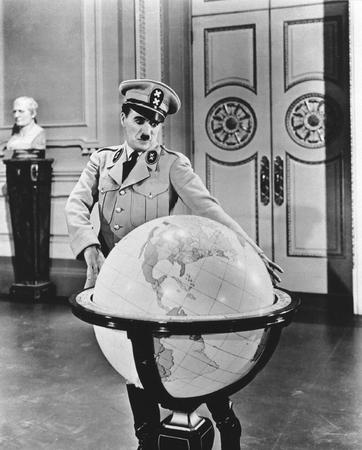
The Great Dictator (1940) directed by Charlie Chaplin
Chaplin and Hitler, two men forever linked in our minds because of one distinguishing feature, the toothbrush mustache. How ironic then that one man would help popularize the style and the other would guarantee it'd never become fashionable again. It was this distinguishing similarity that actually inspired Charlie Chaplin to make The Great Dictator, a satire on Adolph Hitler and Nazi Germany, not his best film but perhaps his most important one for its political views and bravery. Chaplin and Hitler actually shared a lot in common; they were born four days apart in 1889, both grew up in relative poverty with alcoholic fathers and ailing mothers, but that is where the similarities stopped. Charlie Chaplin Jr. had this to say about the parallels between his father and Hitler, "Their destinies were poles apart. One was to make millions weep, while the other was to set the whole world laughing." (Wikipedia!)
The Great Dictator begins during World War I where a Jewish barber-soldier (Chaplin) is in the front lines for the fictitious country of Tomania. He helps save the life of a commander by flying them out of trouble, but crashes the plane causing him to get amnesia. Twenty years go by and he is released from the hospital to a different Tomania than he remembered, one where Adenoid Hynkel (Chaplin again) has taken over and where Jews are openly persecuted.
We first see Hynkel delivering a speech to a large crowd in impassioned and fiery German. Chaplin studied Hitler's speeches carefully for this role understanding that Hitler drew much of his power through his oratory skills. He makes it a point model Hynkel after Hitler and to also make him look like a total clown at the same time. In fact, Chaplin is not even speaking German at all, he's just speaking nonsensical gibberish that sounds like German. Perhaps this was a way for Chaplin to point out that Hitler's ideology was in fact pure nonsense. If you listen closely, he even says the phrases "cheese'n'crackers" and "large beer."
The narrative splits its time between the Jewish barber and Hynkel, one story showing the Jewish perspective during Nazi Germany and the other parodying Hitler. Because of this the film can feel a little disjointed as the two stories don't really interconnect until the very end and it goes long stretches (like twenty minutes at a time) without one character or the other on screen. The Jewish barber's narrative seems like its missing scenes at times. For instance, he is shown escaping a concentration camp in a soldier's uniform, yet it never is explained or shown exactly how he escapes which seemed like a perfect spot to put in some classic Chaplin physical comedy and gags.
While the movie is humorous, I wouldn't go as far as to say it is really funny. I smiled at some of Chaplin's antics but never found myself with a full grin. The best parts are obviously when Hynkel is on screen because Chaplin makes sure to poke fun at him as much as possible. I liked the scenes when Benzino Napaloni (a caricature of Benito Mussolini) visits where Hynkel attempts to look more superior to him. It is explained to him that he should always be seated in a higher position looking down on him, leading to a hilarious barbershop scene where both men frantically adjust their chairs up and up.
It's impossible to really talk about this film without discussing the ending, but I don't really think I'm ruining anything by doing so. It should become apparent that at some point the barber and Hynkel will be mistaken for each other. (Otherwise why have the dual roles?) In the end, the barber posing as Hynkel makes his famous speech. Chaplin looks straight ahead to the camera, drops out of character, clearly speaks as himself and delivers a three plus minute monologue, calling out the evils of fascism and prejudice and pleading for freedom and unity. If you stop to think about it, this speech actually disrupts the narrative and has a completely different tone from the rest of the film; you can even go as far as to say it ruins the movie. But isn't this why Chaplin made the film in the first place, to launch an attack on Hitler? It was evident to me while watching it that Chaplin didn't care how this speech looked in the context of the movie, he clearly needed to get this off his chest and I applaud him for the courage and conviction in doing it.
Chaplin started filming The Great Dictator in 1938 when the rest of the world had a policy of appeasing Hitler and Hollywood for the most part remained mum on the subject. Chaplin, who worked independently from the major studios, spent $1.5 million of his own money on the film (if this movie failed it could have bankrupted him). Clearly he felt had something important to say. By the time the film was released in 1940, Germany was in an all out war with the rest of Europe and the film was greeted with open arms. The Great Dictator, while being a good film, is far more important in a historical context than a cinematic one, though often times there is little difference between the two.
Grade: B
Tuesday, August 9, 2011
Day 111 - Rio Bravo
Rio Bravo (1959) directed by Howard Hawks
It's kind of funny watching Rio Bravo after seeing High Noon because you can see the not so subtle attacks on the earlier film. While both films have the same basic story line, they have markedly different philosophies producing two different yet equally compelling films.
High Noon tells the story of a single sheriff who must fight the bad guys on his own. He tries to enlist the help of his fellow townsmen but no one steps up so he is one man versus the world. At the time some people interpreted it as standing up to the House on Un-American Activities Committee (HUAC) and McCarthyism. John Wayne, ever the patriot and active supporter of blacklisting, went as far as to call the film "the most un-American thing I've ever seen in my whole life." He would team up with director Howard Hawks to make Rio Bravo partly in response. In this film, not only does John Wayne and his ragtag group of deputies face off against the bad guys on their own, he actually rejects the idea of getting more people to help.
Pat Wheeler: What about my drivers? you could use them.
John T. Chance: Supposing I got 'em. What'd I have? Some well-meaning amateurs, most of 'em worried about their wives and kids... No, Pat. I'd just be giving them more targets to shoot at. A lot of people'd get hurt. Joe Burdette isn't worth it. He isn't worth one of them that'd get killed.
Knowing the history of the two films, it is hard to think of this scene as anything but direct criticism to Will Kane's plea for help in High Noon.
Of course Rio Bravo stands tall as its own film. It is regarded as one of the great westerns (along with High Noon) not for any message or social commentary it may contain, but for being a great film, period. It is a movie filled with heroism, action, humor, and romance. It has memorable characters and strong performances from its stars. In short, it has a little bit of everything.
In the film, Sheriff John T. Chance arrests Joe Burdette for killing a man. Burdette is the younger brother of powerful Nathan Burdette, who wants his brother free. It is up to Chance and his men to hold Joe in jail until the US marshals arrive or until Nathan's men break him loose, whichever comes first.
The star of the film is of course John Wayne who struts his trademark machismo. To be honest, I'm not the biggest John Wayne fan. I've always felt like he looked a little stiff on screen and the way he talked seemed so unnatural. That isn't to say I think he sucks or anything, just that I think his image and persona exceeded his reputation as an actor. That being said, I think he's fine in this movie and displays a surprising amount of charm particularly in his scenes with Angie Dickinson.
The best performance of the film belongs to Dean Martin who plays Dude, the town drunk and the sheriff's deputy. His character is the most well developed and shows the most dimensions. In the film he goes through stages of self-doubt, self-pity, redemption and heroism. I thought Martin was great in this role and showed great range.
One thing I did not expect from Rio Bravo was how funny it is. It's not billed as a comedy by any means, but it knows how to space out its story with humorous bits. The two characters Stumpy and Carlos are there seemingly just for comic relief. Stumpy's crazy accent was a little tiring after a while though. There are also a bunch of scenes where characters just shoot the shit with casual banter. Some people might find these scenes unnecessary since they don't really advance the plot but I love them as long as they are interesting and/or funny. It also goes a long way in building up the characters. By listening in on these conversations, it kind of feels like we're hanging out with them and thus they become more relatable.
Rio Bravo clocks in at almost two and a half hours but doesn't really feel that long because the story moves along briskly. It has a good story with interesting characters and just the right amount of action and comedy to fill in the gaps. I still prefer High Noon, though you can't really go wrong either way.
Grade: B+
Monday, August 8, 2011
Day 110 - Winter's Bone
Winter's Bone (2010) directed by Debra Granik
Sometimes I forget just how big America is. There are parts of this country that bear so little resemblance to where I live that it might as well be a different country on the other side of the world. I felt this way when I first saw Fargo. I was just fascinated by how these people talked, acted and even looked. It was just so wonderfully bizarre to me. I felt the same when while watching today's movie, Winter's Bone, set dab in the middle of The Ozarks.
Winter's Bone is about a girl named Ree Dolly just trying to survive. She's in charge of the household taking care of her two siblings and her sick mother. Her father is a meth-cooker and hasn't been around since forever. Ree and her family are living in poverty, relying on the help of her neighbors for food. She even has to give away the family horse. One day the sheriff comes by and says that her father Jessup is due for court and that the house is part of the bond. If he doesn't show up they'll have to take away the house. She responds firmly, "I'll find him."
A fascinating element of this film is that we are transported smack dab in the middle of this small community where everybody knows each other and very little needs explanation. This allows the film to unravel layer by layer, revealing a little bit at a time through each character and each conversation. We learn that Jessup and his meth cooking is well known throughout the community and that everybody seems to be in on it in some way or another. There is a hushed silence when his name is brought up and Ree is barking up the wrong tree, sticking her nose where it doesn't belong.
In watching Ree's sort of odyssey throughout Winter's Bone we see two of the film's greatest assets, the strength and determination of Ree and the The Ozarks itself which is so perfectly captured in look and feel. I'll talk about Ree first. Jennifer Lawrence gives a powerful performance as an ordinary heroine. She feels so real, so authentic and boy, does she look tough. Growing up in a community of roughnecks and criminals, Ree cannot show the slightest weakness, which is what makes her one scene of vulnerability so jarring. Alone in the woods with her comatose mother, she asks for help knowing no one can answer her and she allows herself to cry. The rest of the time she defiantly confronts adults with no fear. In her toughest scene, after being roughed up, her tormentors ask her, "What do we do with you?" to which she replies, "Why don't you just kill me... or help me."
Like Fargo, Winter's Bone is all about the setting. It's about the distinctive way they talk. It's about the way they look and the way they dress. It's about the poverty stricken backwards community. It is also about the little things, like hunting for squirrels and plucking at the banjo.
This film is gritty and real, kind of like if The Wire but set in The Ozarks, ha. It's mostly restrained, but also has its powerful moments too. I enjoyed the film, particularly in its characters and setting, but as far as actual story telling goes, it won't really excite, though it may chill. I won't go as far as to say it is mesmerizing, but it certainly is captivating and makes sure to grab hold of your attention.
Grade: B+
Subscribe to:
Posts (Atom)