Saturday, August 20, 2011

Day 122 - Orpheus

Orpheus (1950) directed by Jean Cocteau


I had to do a quick Wikipedia check on Orpheus as my Greek mythology is a bit rusty. To sum it up in one sentence, Orpheus is a legendary musician who goes into the depths of Hades to bring back his wife Eurydice from the dead. Jean Cocteau's 1950 film is a retelling of the classic Greek myth set in 1940's Paris.

Orpheus is an older famous poet who is hated on by the young hipster crowd. As Jay-Z raps, "Is this what success is all about? A bunch of niggas acting like bitches with big mouths?" A fight breaks out at the local cafe aptly named "Cafe des Poetes" where a young up and comer Cogeste gets run over by a couple of motorcycles. Just as quickly, The Princess rolls up in her Rolls Royce and takes away the body, asking Orpheus to come along as a witness. He hops in but much to his surprise, they don't stop at the hospital but go to a creepy chateau instead. By this point it is clear that Cogeste is dead, but The Princess is unperturbed and tells Orpheus to stop asking stupid questions. Much to his shock, he witnesses her raising the young man back to life and he can only watch as they disappear through a solid mirror.

The Princess is of course Death and the incident with Cogeste is her just doing her job. I don't think I'm giving anything away when I say that eventually Orpheus's wife Eurydice dies, but the manner in how she does is much different from the Greek myth. Cocteau adds in a complicated love triangle where The Princess is in love with Orpheus, Orpheus in turn is obsessed with her and The Princess's chauffeur Heurtebise is in love with Eurydice, so everybody has their own motives throughout the film.

Orpheus is yet another of those heralded classics that is wasted on my inferior tastes as I didn't fall head over heels for it, though in the end I liked it, or at least I think I did. This film probably is deserving of all its praise, and I can certainly see the appeal, but I'm not quite "there" yet to fully articulate why it is considered a masterpiece. I do think that it says a lot about a film though that I can sit through it and be impressed without being able to fully explain why. When I first saw 2001: A Space Odyssey I knew I was watching something great even though I still can't really tell you what the ending is about.

One of the great elements of Orpheus is the style. The film has this strange dream-like feel to it which is accentuated by the special effects. Characters are shown passing through both worlds through mirrors. A close up shows the actors' hands passing through creating a ripple effect, similar to something out of The Matrix. I didn't realize it at first, but that is actually water (which is a natural mirror too). I assume that the other side of the mirror in some scenes is just an identical set on the other side. The other effect which is used a lot is simply playing film in reverse. A shattered mirror fixes itself back into place, dead bodies stiffly rise back to a standing position, gloves jump on and off hands. It is such an absurdly simple trick yet so effective. In Carrie, Brian DePalma filmed a scene backwards, then run in reverse to give the scene a more surreal effect. There is something about playing around with time that gives these film the dream-like feel.

The film does have its problems though. When watching foreign films I'm usually too busy reading the subtitles to notice the acting, but I thought it was mediocre at best. Nobody really stood out to me. I also had problems with plot elements and the characters themselves. So, Orpheus is not allowed to ever look at Eurydice again, yet Eurydice seems to have no qualms at all about it and wants to live like normal. This would create an obvious strain on them and to be safe, they shouldn't even be near each other, yet she doesn't seem to take the threats seriously as she just walks in and out of his line of sight. If I knew looking at someone would mean instant death for them, pretty much the only solution would be to split apart. That may be the point of caveat though, a sort of gift and a curse to be with the one you love, except that by this point Orpheus doesn't seem to really love Eurydice.

Okay, somebody who has seen this movie please tell me what the ending is all about? So Orpheus and The Princess want to be together forever and they seem to have achieved that but then why does she renege on it to return him back to the living with Eurydice? I don't get the sense it was some sort of self sacrifice because it doesn't seem to serve an actual purpose. She never really has any compunction about Eurydice's death or give any indication that they actually should be together so why return him to her? Some parts of the film don't make much logical sense even if it is a fantasy based movie.

Overall, this film had enough to hold my attention and for me to enjoy it for the most part. I didn't care for some parts and I twiddled my thumbs through others, but I cannot deny that it interested me throughout even if it did leave me scratching my head. Like I said though, it may very well be a great movie, I just lack the insight to realize it. It may take a couple more viewings for its greatness to sink in or just some more movie watching and thinking under my belt. Already, I can tell that I have undervalued some of the films I have watched, as I still occasionally think about them, wondering about this or that, replaying a certain scene in my head. That is usually a very good sign for them as movies and maybe I'll think about Orpheus like that too.

Grade: B

Friday, August 19, 2011

Day 121 - The Guard

The Guard (2011) directed by John Michael McDonagh


An almost sure fire way to make a compelling movie, or at least a compelling idea for one, is to take two completely contrasting elements and stick them together. Cowboys and Aliens, for instance, sounds like a pretty awesome idea; it just needed better execution. So what would be stranger than pitting a cowboy up against an alien? How about sticking a black guy in the middle of Ireland? Or more precisely, buddying up Don Cheadle with Brendan Gleeson in one of the funniest duos in recent memory. Their characters are literally as different as black and white and are so obviously mismatched for each other that it is almost guaranteed to work on some level.

Sergeant Gerry Boyle (Gleeson) can almost be described as an ignorant redneck, if Ireland has such a phrase, but he is hard to read. Is he really this ignorant when it comes to black people ("I thought only black lads were drug dealers. And Mexicans.") or is he purposely being offensive? Either way, to the viewer, he is hilarious, though he may not be so funny to Wendell Everett (Cheadle). He doesn't quite know what to make of Boyle; he is almost at a loss for words to how offensive Boyle is yet he is clearly drawn to his personality. He tells him, "I can't tell if you're really mother f*cking dumb or really mother f*cking smart." And to be honest, neither can the viewer.

Boyle is a questionable guard, or guarda, the Gaelic word for polieceman. He tastelessly plays a joke with a dead body at a crime scene, he searches a body for drugs that he can keep for himself in another. Rather than focusing all his energy on the big drug and murder case, he insists on taking his day off to spend some quality time with a couple of hookers. He seems like a pretty morally corrupt individual let alone a cop, yet when all the chips are on the table, he doesn't take the payoff and tries to do right.

He is buddied up with FBI agent Everett who is sent to Ireland to investigate a drug smuggling operation and the sparks fly right away. The two share a back and forth rapport where Boyle will say something outrageous and Everett will respond with a WTF expression. Gleeson and Cheadle are perfectly mismatched for each other and it is a pleasure to watch. Gleeson is the clear star though as he is given the most to work with and capitalizes on it big time, playing a hilarious and complex character.

This movie is well acted all the way around. Gleeson is great. Cheadle is very good. Mark Strong plays one of the bad guys and he clearly has a blast doing so. They are helped by a very sharp and witty screenplay that is funny, vulgar and violent. Also, I can't tell what accent is more crazy, the American midwest one from Fargo or an Irish one. There's even a bit in the beginning of the movie where they can't even understand their own accents.

Grade: A-

Thursday, August 18, 2011

Day 120 - Spaceballs

Spaceballs (1987) directed by Mel Brooks


I'm not really sure how I feel about Mel Brooks. I think his style of obvious farcical comedy isn't very sophisticated. In fact, much of it is juvenile. Much of it isn't even that funny. But his movies are filled end to end with gags and jokes and for every four or five misses, he will hit a home run and have me roaring with laughter. I decided long ago that I didn't care much for him, yet I somehow kept on accumulating his movies over the years; The Producers, Blazing Saddles, History of the World, Robin Hood: Men in Tights, Young Frankenstein, and Spaceballs (which I watched for the first time today). Despite my doubts about Brooks, I realized that I actually liked his movies. I distinctly remembered sitting through a couple of those films and thinking to myself, "Man this is really dumb," yet by the end of them, I thought, "I guess that was pretty funny. I had a pretty good time." And that's all you're really looking for in a Mel Brooks film, a super light weight kick back and relax have a couple of laughs good time.

Spaceballs is a Star Wars parody that probably feels less fresh today than it did years ago, before everyone and their mother made some type of Star Wars spoof, but it is still a pretty funny and enjoyable film. The film features the likes of somewhat familiar faces such as Dark Helmet, Pizza the Hutt, and Yogurt. I almost choked when I saw Pizza the Hutt, part of it due to my laughter and the other part to my disgust; he really is an awesomely gross looking character. The hero of the film is Lone Star, who is obviously Han Solo, yet dresses like Harrison Ford's other famous character, Indiana Jones. There is Barf, a half man half dog, hence a "mog." He is supposed to be Chewy. Princess Vespa is Leila and she is accompanied by a CP30 type droid, though surprisingly no R2D2. The plot is really an afterthought, so I won't even bother to mention it. But in case you're wondering, it doesn't completely follow the Star Wars storyline. After all, the purpose of the film isn't to do a shot by shot remake, but to simply set up scenarios for familiar scenes and lines.

As is customary with Mel Brooks' films, the focus is on the jokes and there are lots of them. Also customary is the fact that many of the jokes are stupid and not very funny such as the continuous gag of Dark Helmet bumping his helmet into things or the character of Yogurt all together. But some of the stupid jokes can be very funny as well. I laughed pretty hard during the scene when Dark Helmet is playing with the dolls. I laughed at some of the Jewish jokes and I'm not even Jewish! I laughed at other random things. That is all that really matters anyways, how much did you laugh, how much did you sit there stone faced refusing to crack a smile?

My guess is you either dig Mel Brooks or you don't, though some of his films are clearly better than others. I'm afraid Spaceballs falls somewhere on the lower spectrum of his movies, but for the most part I enjoyed it. It helps a lot to be a Star Wars fan to begin with, the bigger the better obviously to really enjoy it. That makes sense of course because what are you doing watching a satire of a movie you don't even care for to begin with? And if you don't like Star Wars, that probably means that you smell funny or you're a Communist, probably both.

Grade: C+

Wednesday, August 17, 2011

Day 119 - Attack the Block

Attack the Block (2011) directed by Joe Cornish


This movie has the guise of being about an alien invasion, but it's more about overcoming prejudices and coming of age. Don't believe me? Then consider this question one of the characters ask. Out of all the places in the world for aliens to land, why would they pick a poor neighborhood in London? Obviously to set up some hilarity and absurd scenarios, but the real point is for our little hoodlums to become heroes. Okay, I'm exaggerating quite a bit; this film is pretty light, but that's okay. I don't mind light. I don't even mind if it's a little bad. I just like to be entertained and Attack the Block, for all its flaws and silliness, is entertaining.

The film opens with a group of teenage hoods mugging a woman in a sketchy neighborhood of London. Just as things may look to get a little too sour for the damsel in distress, a meteor-like object falls from the sky and smashes into a car next to them allowing her to escape. Despite everything the teens may have seen in horror movies, they check it out and SURPRISE! a scary werewolf looking alien pops out. But little does the alien know that it just f*cked with the wrong bunch of kids from the wrong block in the wrong hood. I'm sure it must be quite a shock to it when these kids start chasing it with bats and knives rather than run away.

The irony of the film is that in the midst of this alien invasion, nobody even seems to notice or care that a bunch of werewolf alien hybrids are roaming the streets. The police are more concerned with catching the thugs that mugged the woman and arresting them for the wrong reasons. (The expression is charged for "driving while black.") The woman sees two police officers mauled to death by these otherworldly creatures and assumes the thugs must have had something to do with it. The local crime lord doesn't seem to realize the severity of this situation and instead focuses in on the young kids who smashed his ride. It is up to the young teens then to save the day.

The woman that they mugged eventually joins them as she is reminded "We're all on the same side here" when it comes to the aliens. Obviously they grow to understand and maybe even respect each other and maybe in some other circumstance or scenario they could have been friends. But of course we know that's not true. Without the alien attack, she would just go on clutching her purse a little tighter when walking by a group of black kids and the kids would still see her as another easy mark. There's nothing that unites people together more than a common enemy or shared tragedy. Take America's national pride during WW2 and 9/11 as examples. Unfortunately it usually takes these extraordinary circumstances for people to drop their prejudices and come together.

Oh, as for the movie itself? It's kind of scary, kind of funny, kind of corny (something Cowboys vs. Aliens should have purposely been), obviously ridiculous, and surprisingly deserving of its R rating. I hesitate to say that it is a really fun movie because it isn't quite as outrageous as you'd assume, but it is still silly enough to have a good time.

Grade: B-

Tuesday, August 16, 2011

Day 118 - Still Walking

Still Walking (2008) directed by Hirokazu Kore-eda


I didn't realize it at first, but I've seen one of Hirokazu Kore-eda's movies before. I watched After Life in a Japanese cinema class in college and it was one of the most profound films I had ever seen. The basic question the film asks is "If you could only take one memory with you for all of eternity what would it be?" It is a great movie, but I don't think I'd ever want to watch it again because of how deep and emotional it is. Apparently many of Kore-eda's works deal a lot with death, loss and memory. These themes are at the heart of his masterful Still Walking.

Every year, the Yokoyama family gather together to commemorate the death of the eldest son, Junpei, who drowned over a decade ago while saving someone's life. Ryota, the second son, dreads these trips back home. His father had always favored Junpei and disapproved of Ryota. He is especially worried this year as it is the first time his parents will meet his new wife Yukari and step-son. He is worried what they will think as she is a widower. (His mother tells his sister that it is almost better if Yukari were divorced instead of widowed; at least divorcees chose to leave their husbands.) When Ryota arrives at his parents' house, you can see the unease gather in his face, the tension in the room as he greets his father, the nervous anticipation as his mother sizes up Yukari. It is one of the rare occasions when both the surviving children visit, but it is a bittersweet ruinunion and only a reminder of Junpei's absence. Ryota, overshadowed by his brother in both life and death, cannot wait to get out of there.

The film is all about suppressed emotion, underlying tension, things that are left unsaid, unresolved pain and subtle yet powerful moments. The story is deceptively quiet but there is so much boiling underneath the surface. The story focuses on just this one day, but the thoughts and emotions that you see have been there ever since Junpei's death, if not earlier. I loved how the film says so much by saying so little. And the stuff that finally does get said can hurt so much, or uplift even higher.

I basically loved everything about this film; the acting, the direction, the unique compositions, how touching the story is, how simple yet complex it is. It would be easy to gloss over it and say that nothing really happens in the film and you'd be somewhat right. Nothing really gets resolved, not much really happens in terms of action, but I don't think that isn't the point of the film. It is meant to be a vehicle for emotion, for thought. It is supposed to touch and it certainly does.

Grade: A


Sorry for the crappy entry (I realize I didn't really say anything specific about the film basically only generalizations), especially for such a great film, but I was out all night/morning and this is the best I could come up with after being up almost 24 hours...

Monday, August 15, 2011

Day 117 - The Help

The Help (2011) directed by Tate Taylor


This book has been near the top of the best sellers list for over a year now and I've always wanted to read it. Now that I've watched the movie, I don't know if that's going to happen anytime soon if at all. It's funny, I almost always watch the movie of a book I've read, but never the other way around. I think that's probably true for most people. There is an easy explanation for this; books take days if not weeks to read, movies take two hours. It's very difficult to get into a book, to invest a week into it, if you already know all the details. On the other hand, everybody wants to know how the book they read turns out on screen, if it's how they pictured it when they read it.

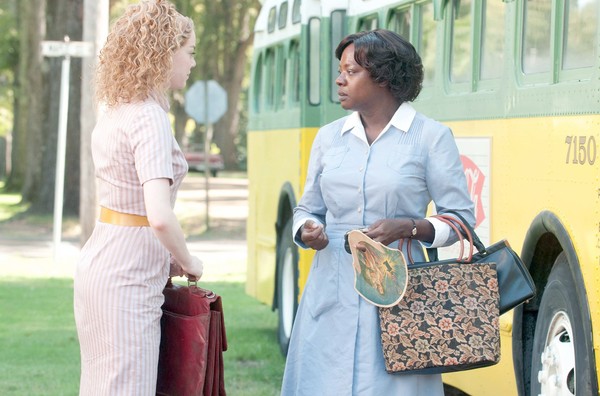
The Help captures a period in American culture where having black maids was common practice for white families especially in the south. These women were called the help, but they were much more than that; they kept houses together and in many cases raised other people's kids for them. It must be a strange feeling to bring up and care for your future employer who will most likely turn out to be a racist jerk like the rest of them. But perhaps that is why Aibileen (Viola Davis) takes such great interest and love in these white kids, that they may grow to be better people than their parents, that perhaps they will be the ones to enact change in this hostile environment. She recites a couple words of inspiration to her young ward throughout the film, "You is kind. You is smart. You is important." At least one white person was brought up right and that is Skeeter (Emma Stone), a young woman who has taken the lessons her family maid taught her to heart and whose care and affection she has never forgot. She sees the hypocrisy and blatant bigotry around her and decides to do something about it, to write a book from the perspective of the help.

Thematically The Help is somewhat similar to Driving Miss Daisy, a film I decided that I hated due to its obvious pandering and racial stereotyping. The Help is also very obvious and purposely manipulative; it seems almost impossible to make a film like this without being so. Yet I enjoyed this film much more than the 1989 Best Picture because it did not involve the one dimensional selfless servant that Morgan Freeman played. Instead, The Help features characters who have some more wrinkles to them; they are tired, guarded, and brave enough to stand up to the whites. Yes, they are spruced up a bit; the scenes with Aibileen and the young child are obnoxiously sentimental, but what can you really expect?


The film centers around Skeeter's attempts to get Aibileen, Minny (Octavia L. Spencer), and whoever else wants to volunteer to tell their stories of what it is like to work for white families. This takes substantial courage as it is against the law in this part of the South (Jackson, Mississippi) to promote this type of talk. This is an era where Hilly Holbrook, the woman who Minny works for, is attempting to pass a law that requires every house to have a separate bathroom outside for their Negro help. It is hard to imagine a character as viscous as Hilly existing; she is painted to be an obvious villain in a story, but sadly, people like her really did, do, exist. 


The strength of the film is in its performances. This is the first non-comedic role I've seen Emma Stone in and she shows a young eagerness and perhaps a little nativity in her portrayal of Skeeter, qualities necessary to take on the establishment. Viola Davis, who earned an Academy Award nomination for a powerful eight minute role in Doubt, displays a quiet strength throughout the film though as I previously mentioned, she is given some extremely obvious scenes that I could have lived without. Octavia Spencer is a pleasure to watch. She is given a lot of funny moments (including a gag with a pie that brought the house down) and plays Minny with sass and energy, but yes, her role is somewhat of a stereotype of the big black Mammy image. (Is it a coincidence that her name is Minny?) Those are the three principle characters though I also enjoyed the character of Ceila (Jessica Chastain), an outsider to Jackson who struggles to gain acceptance in the community. She can relate to the blacks and her greatest moments come in bonding with Minny.

The Help is an obviously manipulative inspirational tearjerker, but I don't really mind being manipulated as long as I don't feel too dumb afterwords. It is a pretty obvious movie, though it points to a nice and cozy place in your heart and maybe that isn't such a bad thing.

Grade: B


Sunday, August 14, 2011

Bonus - Fargo

Fargo (1996) directed by Joel Coen


I hadn't seen Fargo since forever, so long ago that I practically forgot the plot. I rarely feel the need to see a movie more than once or twice, which makes my ever expanding DVD and Blu-ray collection kind of pointless, but I like to buy them for those special occasions in the off chance I may just decide to watch a particular movie again. How long should one go between viewings? Perhaps not so soon as to remember every little detail but not so long as to have completely forgotten everything; sometime in between where you still have that sense of excitement but familiar enough as if you were catching up with an old friend.

Fargo tells the story of a man who hires a couple of thugs to kidnap his wife so he can pocket the ransom money from his rich father-in-law. It's supposed to be a quick and easy job, no one gets hurt, everybody walks away happy, except things never go according to plan and things spiral quickly out of control. The plot itself is almost an afterthought; Fargo is really about the setting, the characters, the depiction of friendly midwest life. Watching this film is so fascinating because its like watching a documentary about people from the upper midwest. Are these people real? Do they really talk like that with those crazy accents and smily faces? Do they really say stuff like "you betcha" and "you're dern tootin'"?

This surreal setting makes the sudden moments of violence so shocking. I sort of criticized or questioned this juxtaposition of friendly suburban life with violence while discussing Blue Velvet, but Fargo pulls it off so much better and with more purpose.

The film is highlighted by the performances and everybody is great. William H. Macy plays his part perfectly. You can sense his bad decisions weighing down on him in how he tries to mask his fear and concern behind his gee-golly exterior. It is also a credit to the Coen Brother's writing because every single stutter and stammer that Macy speaks is actually written into the screenplay. The two criminals, Steve Buscemi and Peter Stormare, make for an interesting duo; one is a nervous talker, the other is calm and silent, one has an imposing figure, the other is referred to as "the little fellow." They are a contrast in styles but they fit so perfectly together. Of course, the main star is Frances McDormand who just owns every scene. She actually doesn't come in until deep into the movie but she quickly takes over as the lead. The first time she says something with her crazy accent I couldn't help but smile. There is one scene where she basically just says "Yah" and it's just hilarious. Her facial expressions are gold and she gives off this small town demeanor but is actually a very smart and capable cop.

This movie is so good, probably the best film the Coen Brothers have ever made, maybe the best film they ever will make. I loved everything about the film; the drab yet beautiful cinematography, all the characters, the depiction of friendly midwestern life, the humor, and the shocking violence. Everything hits at such a perfect note, with such rhythm and artistry. I remember really liking Fargo all those years ago, but I never realized how much I loved this film until watching it again today. Luckily movies are not like people. They won't get upset for missing their birthday or forgetting to call; they'll always be there waiting.

Grade: A