Thursday, December 8, 2011

Day 232 - Waiting for Superman

Waiting for Superman (2010) directed by Davis Guggenheim


Imagine your kid's future being decided by random luck. If your kid gets chosen he or she will be able to attend a charter school that does better than even the glitziest private school. He or she will graduate high school, likely go to college and get a good job and exceed in life. If your kid doesn't get picked he or she will have to go to the local public school where, in some schools in America, have an astronomical 80% drop out rate. He or she will be exponentially more likely to wind up in prison, die at an early age, or live at or below the poverty line his or her entire life. Your chances of winning this lottery? About 1 in 20. That means 19 in 20 will wind up at the mercy of a public school where the odds are stacked against them to succeed before they even set foot inside. The fact that we even need these lotteries just for our kids to have a chance at a decent education is indicative of just how far America's education system has fallen. In Waiting for Superman we follow five kids who enter the lottery in hopes of getting into a better school. I won't say who gets in and who does or if any do at all. That is sort of besides the point, their stories are just one of many all across the country. The ridiculousness of the lottery, despite being fair and unbiased, just goes to show that our school system does not work.

If there is one thing to take away from this film, I would say it is the power of teachers. There is no greater impact on a kid's education than a teacher. A really good one can improve a kid's proficiency by several grades in one year. A really bad one can actually lower it. This is partly why charter, private and prep schools are so successful, they can handpick their own teachers, whereas public schools are stuck with their teachers basically forever. For as much as people talk about how little teachers get paid, they actually have it pretty good in another way. They are virtually impossible to fire once they've gotten tenure, whose only requirement is to teach for a certain amount of years regardless of how good they are at their job. It takes nothing short of being a serial killer to get fired once you've gotten tenure. There have even been instances of child molesters who could not be fired. (A teacher at my elementary school was still teaching while he was under investigation for child molestation.) The teachers' union as a whole would like to keep it this way to protect the bad and ineffective teachers, but at the same time it actually hurts the good ones. Everything in the union is based on seniority rather than performance. Teachers would be wise in the long run to abandon this tenure system and actually reward their good teachers and cut off some dead weight.

If I ever have kids I think I would like them to go to a private school. Taking a vested interest in their education is the best thing you could for your kids. For more on the subject of America's education, I'd suggest That Used to Be Us: How America Fell Behind in the World It Invented and How We Can Come Back, which has a very informative and logical section on why education is so important to our future.

Grade: B

Wednesday, December 7, 2011

Day 231 - Days of Heaven

Days of Heaven (1978) directed by Terrence Malick


Terrence Malick is described as an artist first, film maker second and it shows in his films. Days of Heaven is one of the best looking films I've ever seen. Every scene is like one of those classic paintings of the rustic countryside with sunsets, red skies and vast sweeping fields. At times the movie almost feels like a series of paintings rather than a film. Days of Heaven is a strange movie because it places so much emphasis on the look and feel of the film and purposely downplays the story by keeping it a distance.

The story is about two lovers, Bill and Abby, who go to Texas after Bill kills a boss in a dispute. The two of them, along with Bill's sister Linda, work as farmhands for a wealthy but dying farmer. Bill and Abby devise a scheme for Abby to marry the farmer so that when he dies she will get the money and they can live happily ever after. Enter love triangle, welcome typical drama. It would seem like a pretty complex and rich story filled with human drama but it doesn't really play out that way. The story is observed rather than experienced. Heated arguments are seen from a distance but never heard. We never really see the moments of tenderness between the adults. This is because the film is told from the perspective of the little sister Linda rather than any of the three principle characters. She narrates the film with a profound sadness perhaps out of longing or the inevitable failure of the love triangle. We don't feel the emotion in the film because she doesn't feel them. Yet I wouldn't say this film isn't emotional. There is true beauty in the images on screen which can be just as moving as a well defined story. The setting captures this moment, these days of heaven, with such beauty yet also reflects upon them with deep sorrow, if that makes any sense. Linda's narration is also quite chilling which adds to this feeling. I don't think the film is particularly deep or anything but it isn't simply pretty pictures either.

Grade: B+

Tuesday, December 6, 2011

Day 230 - The Wages of Fear

The Wages of Fear (1953) directed by Henri-Georges Clouzot


The Wages of Fear is the original Ice Road Truckers, the popular TV show about truck drivers who risk their lives delivering goods on dangerous roads. In this movie four men go on a suicide mission to drive highly explosive nitroglycerine across 300 miles of dangerous road where any little bump or mishap could cause them all to blow up.

First I'd just like to point out that once the trucks are on the road, the film is very exciting and suspenseful.  It is a truly great thriller. However, I could have done without the thirty minute set up that doesn't even really set it up. In the early scenes we come across a poor South American town where people are sort of trapped. There are no good jobs and it is virtually impossible to leave because tickets out are so expensive. This could have been established in 15 minutes top but instead we are treated to extended scenes that don't amount to much and it's not like they are brimming with character development. We learn far more about the characters once they are on the road.

When they finally do hit the road it is pretty amazing how long the film can hold the tension. I think the key is that the four characters are divided into two trucks. We know that they must get further otherwise the movie will end prematurely but we do not know the rules of the story. Will both trucks make it out or will one blow up? Or maybe they both blow up? There are several major hazards on the road that the trucks must navigate that are filmed with great suspense. One is where they must maneuver past a creaky wooden part of the road that hangs precariously off the cliff. It is daring and dangerous in all the obvious ways we can see. Another is when a huge rock blocks the pathway and they decide to use some of the nitroglycerine to blow it up. While in the other scene we can see just how close the trucks are to the edge, in this scene all the tension is implied because while handling the nitroglycerine they could blow up at any moment with even the tiniest mishap. You know all those movies where the hero must diffuse the bomb while the timer ticks down to zero? During this entire film the timer is stuck at :01.

Another important part to the film is in the characters and how they handle themselves. The team of Luigi and Bimba are kind of secondary characters but they are given ample screen time to gain or sympathies. The conflict of the film is between Mario and Jo. It turns out that Jo is a coward but what is interesting to me is that the film doesn't really go in the direction I expected with him. Semi-spoiler in white: There never really is a moment of redemption for him. He basically sucks throughout the whole film. I thought the final sequence was pretty interesting and also very unconventional compared to the typical Hollywood ending. It is a little nihilistic but that isn't really a bad thing.

The Wages of Fear is a great thriller but could have used a bit of trimming. My only other complaint is that Mario and Luigi should have been on the same team! (Also they got it backwards here, the short chubby guy with the mustache should have bene named Mario while the tall skinny guy Luigi.)

Grade: B+

Monday, December 5, 2011

Day 229 - Snow White and the Seven Dwarfs

Snow White and the Seven Dwarfs (1937) directed by David Hand


Snow White is so famous that it invariably comes up from time to time so that it remains relatively fresh in my memory. Or that it is so influential that it has become a permanent fixture in my consciousness. I haven't seen this film since I was a little kid, but I feel like I could just throw it on and be familiar with it like an old friend I hadn't talked to in a while. Who could ever forget "Mirror mirror on the wall"? Who could forget the names of the seven dwarfs? (Well, I could. I just watched the film and I don't think I can name them all.) But perhaps more so than the historical significance of the film, it is the very first full length animated feature, or the familiar story any eight year old could recite, it is the feeling you get when you watch this film that leaves the greatest impression. There are a lot of films, even some great ones, that are pretty forgettable. You name a good movie and sometimes the only thing that comes to mind is "That was a pretty good movie." But you name a timeless classic like Snow White and you're not just talking about a movie, you're talking about a piece of your childhood and terms like magical, wonderful and enchanting get thrown around.

Snow White isn't my favorite Disney movie but it is perhaps the one that I respect the most for what it accomplished and the influence it would have. Yeah the story is kind of simple and contrived, but you can't help but admire its charm. I will say that I didn't remember this film being so frightening. You got this evil queen who wants Snow White's heart in a box for crying out loud. There is the huntsman who sneaks up behind Snow White and is about to Norman Bates her. When she flees through the woods it turns alive trying to eat her. These are pretty frightening images to little girls. And let's not even talk about the scene when the seven dwarfs sneak up on the sleeping Snow White. I've seen many videos start this way, haha. (I feel like I had to add in the haha to lighten that comment otherwise you'd just think I was a sick pervert. I take serious offense to being called sick!)

The animation is quite excellent and looks fantastic on Blu-ray, perhaps not quite as good as Bambi, but still pretty impressive. It's kind of insane to think that this entire thing is hand drawn and a single scene could take days if not weeks to do (though I'm sure working with computers present its own set of problems).

There isn't really much else I can say about the film. It kind of speaks for itself.

Grade: A-

Sunday, December 4, 2011

Day 228 - Skin

Skin (2008) directed by Anthony Fabian


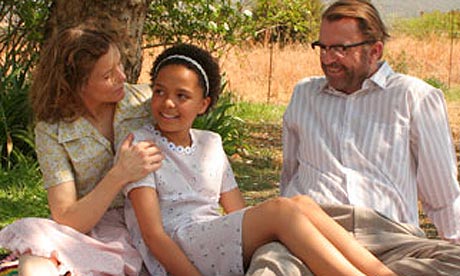
Skin tells the true story of Sandra Laing who struggled her entire life to find her identity in South Africa during apartheid. Her parents are white, but she is unmistakably dark skinned. This is odd, though should not be surprising. After all, as a geneticist in the film states, "many and perhaps most Afrikaners have some non-white blood." In her parents eyes, Sandra is unquestionably white. They raise and love her like any other white child and are outraged when others treat her differently. Her father fights all the way to the Supreme Court to ensure that Sandra is classified as white and eventually gets his way. However, a piece of paper cannot shield Sandra from the realities of the world around her; she is still seen as black and quickly realizes just how different she really is despite what her parents say.

Ironically it is Sandra's father who would cause her the most grief. Just because he has fought for and accepted her it does not mean he accepts blacks. He works closely with them at the store, but is decidedly distant. He tells his wife harshly to do business with them, not talk with them. So when Sandra finds she has more in common with Petrus, a black man, rather than the white men her parents set her on dates with, he is furious. When she runs off with Petrus he disowns her. Sandra is stuck between two worlds. She is neither white or black. In a twist of irony she must go back to the records office where her father once fought for her to be classified as white to become reclassified as black so she can legally live with Petrus and their mixed child; otherwise she is breaking the law. When Petrus grows to resent Sandra's whiteness, she is left all alone rejected by both sides.

The story focuses more on the family drama and Sandra's search for identity rather than the political landscape of the time. There is no need for Mandela or protestors to make appearances because we can see the injustice in Sandra's very existence. It is a compelling story told convincingly by Sophie Okonedo's performance as Sandra spanning several decades. The emotional pay off at the end is rather subdued and not as uplifting or satisfying as one would expect. That is okay though, sometimes we don't need the extra sentimental Hollywood ending to make it work. Just because apartheid ended it doesn't magically erase the emotional turmoil that Sandra had to go through her whole life.

Grade: B

Saturday, December 3, 2011

Day 227 - Hugo in 3D

Hugo (2011) directed by Martin Scorsese


I'll just start off by saying that Hugo makes the best use of 3-D I've ever seen in a film which is pretty remarkable considering it is Martin Scorcese's first big budget special effects feature. What is an old school legend known for his gripping dramas doing making a CGI laden kid's fantasy adventure story? It is easy to forget that even adults were once kids. Undoubtedly young Martin Scorcese daydreamed and fantasized like the rest of us. As a child he was immediately drawn to the magical qualities of film, a wonderful medium for which to tell stories and express dreams and wonder. How fitting is it then that his first children's movie is basically about movies.

Hugo is a young orphan who lives in a Paris train station. He lives behind the walls and goes about maintaining all the clocks in the station incognito, a job left to him by his drunk uncle who left him. His daily routine is fixing the clocks, stealing food and avoiding capture by the station's inspector who loves nothing more than to snatch up orphans. Hugo's real passion however is fixing an old automaton, a robot of sorts, that he and his father were working on before he unexpectedly died. The automaton is all he has left of his father and by fixing it he hopes to reconnect with him somehow. He must steal the spare parts he needs and is caught by a cranky toy shop owner who is visibly upset when he discovers Hugo's plan for fixing an old automaton.

Hugo befriends the old man's goddaughter Isabelle and the two share adventures together. These are fantastic adventures not in the sense of slaying dragons or discovering a pirate's treasure, but in the simpler things that we as adults often take for granted. They explore the train station together, go to a bookstore and sneak off to the movies and these scenes remind us what it's like to be kids again.

The film is broken into two distinct halves, the first being Hugo's story; his chase scenes with the station inspector, uncovering the mystery of the automaton with Isabelle and ultimately trying to find meaning in his life. This leads to the second half of the film where Hugo discovers that the answers to his questions lies with the old toy shop owner who himself struggles to find meaning to his own life. I don't want to give anything away but it inevitably leads to the early history of cinema. These moments are a cinephile's wet dream. Even to casual observers these scenes are enchanting, magical and wonderfully informative.

As I stated earlier this is the best use of 3-D I've ever seen in a film. It's not that things pop out even more, it's how they pop out. For instance in the very beginning of the film we are treated to several long tracking shots that weave through the train station and all the people on the platform and through the walls past all the pipes and gears. As the scene progresses it is like a pop up book unfolding revealing layer after layer of extra depth and dimension. It goes to show that it is not the technology that creates the wonderful effects (though it certainly helps) but the vision behind it to make it all happen.

I really loved the homage that Scorcese pays to these old time classics. There are clips of Buster Keaton and other long forgotten greats. The famous scene where Keaton hangs from a clock tower is recreated later when Hugo attempts to flee the inspector. One of the very first films ever was of a train pulling into a station titled "Arrival of a Train at La Ciotat" (1897). People who were watching that for the first time instinctively tried to jump out of the way. Imagine how those early patrons would have reacted to Scorcese's 3-D version. It is this original sense of imagination and wonder that Scorcese puts into this film.

Grade: A

Friday, December 2, 2011

Day 226 - Life in a Day

Life in a Day (2011) directed by Kevin Macdonald


Life in a Day is a representative look at the world we live in in more ways than one. First it is literally about the world we live in as it chronicles the daily lives of people all around the world that takes place on one single day, July 24, 2010. Secondly how the footage was filmed and obtained is a process of the world we live in today thanks to technology and the levels of collaboration that it has created. A film like this would never have been possible even five years ago. Virtually all the footage was taken from YouTube users, over 4500 hours of video from 80,000 submissions across 192 countries. What is the film about? Basically us.

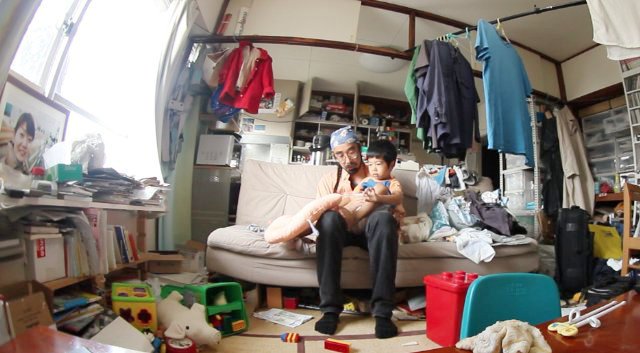
The film begins in the early morning and we are shown clips of people all around the world of people waking up, brushing their teeth, going to the bathroom, eating eggs for breakfast. This film is all about unifying people by showing us we are all the same. We have the same mundane routines, we have the same loving relationships with others, we all put our pants on one leg at a time, as the saying goes. There are, of course interesting individual stories that gain a little more attention. One of the early scenes is a heartbreaking one involving the morning ritual of a Japanese father and his young son. They live in a cramped messy apartment with pictures of a woman adorning the living space. They burn incense at an alter for the woman, the wife and mother, and we realize that the father and son are coping with loss. Perhaps the most symbolic subject of the film is a Korean man who has been biking around the world for the past ten years. He's been to over 190 countries, seen all the different faces of the world and has a dream of one day unifying North and South Korea.

There is no real rhythm to the film. It jumps from country to country, story to story. One moment it follows a young South American boy who shine shoes, the next an old couple are renewing their vows in the funniest and most light hearted moment of the film. We are taken to war torn Afghanistan, then we are shown an anxious wife back home prettying herself up to video chat with her husband who is a soldier half a world away. People are asked simple questions like, "What do you have in your pocket?", "What do you love the most?" and "What is your biggest fear?" Ghosts, zombies, being alone and death seem to be universal answers to the latter.

Being entirely composed of YouTube content there are some pretty amazing videos as well, including a close up of a hand capturing a fly and then releasing it outside where we can see it fly away. The highlight of the film to me was an incredible sky diving scene that would be impressive for a professional cameraman let alone a user submitted video.

The day itself isn't really relavant. It could have been any day of the year and that is the point. Interesting and not so interesting things happen every day in the world. We can find simple pleasure in the mundane, in knowing that someone out there may be doing the exact same thing you are doing. We are never truly alone. Life in a Day is a very interesting concept for a film. Never before have so many different people collaborated in such a project, though this type of work is already part of the world we live in today as the world flattens. Today a man from Sri Lanka may be as close to you as your next door neighbor thanks to the Internet and other technologies.

Grade: B